The Victorian Divers
Just days after the sinking of the Josephine Willis, divers visited the freezing waters of the wreck-site to investigate the possibility of salvaging any of the ship’s cargo and to determine what, if any, of the ship’s structural elements might be raised up from the seabed. This salvage activity was instigated at the direction of Lloyd’s of London, one of the primary insurers of the vessel and its cargo ; their representatives would have been tasked with recouping as much value as possible from the wreck to offset their losses.
Deep-sea diving techniques of the time used air pumped by hand through hoses to what we now know as the classic spherical brass or copper style helmets with small glass portholes. The methods and equipment used for diving on the wreck of the Josephine Willis had been developed by specialist mariners from Whitstable whose families were the foremost proponents of the day. Whitstable was also relatively local to the scene of the wreck-site for these experienced sailing folk. Their work, though, was dangerous, with huge risks from equipment failures, capricious weather conditions, and the unpredictable complications of underwater obstructions snagging on the diving dress or hoses.
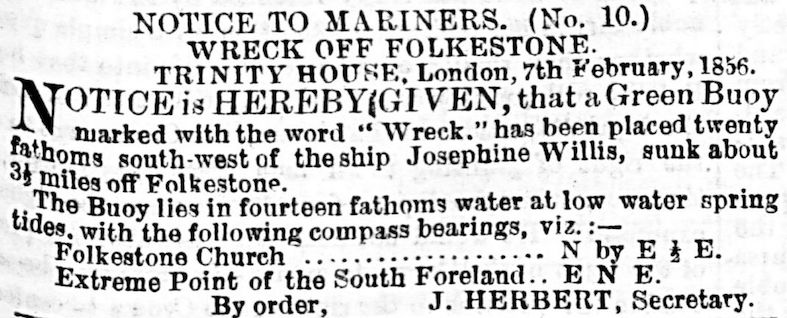
British Newspaper Archive - Public Domain
The wreck was lying in the fairway of a busy shipping channel; within a week of the collision, the Trinity House Corporation had arranged for a “wreck buoy” to be placed 20 fathoms (36.5 meters) south west of the wreck to warn passing shipping of the danger of the submerged hazard.
Nonetheless, within a fortnight of the placement of the buoy, a near miss of another catastrophe was reported:
MIRACULOUS ESCAPE FROM SHIPWRECK – On Sunday morning last, about three o’clock, the schooner, Anne Louisa, Captain Alfred Fuller, of this port [Rye], while on her voyage from the north, passed completely over the Josephine Willis, which is sunk off Folkestone. They had perceived nothing of the wreck until they were directly over it, when the mate saw a mast on each side of the schooner. They were sailing seven knots at the time, and had they struck against the sunken vessel, the consequences must have been serious, if not fatal.
(South London Journal, 26th February 1856).
The divers that worked on the wreck were employed under the superintendence of Captain Edward Bunbury Nott, R.N., Special Agent for Lloyd’s, based at Deal. Special Agents had been put in place by Lloyd’s at strategic ports to represent the insurance underwriters and to prevent fraudulent claims against them. The specifics of the diving efforts were arranged and coordinated by Mr. Wallace Bell of Whitstable. The divers working under him on the Josephine Willis salvage operations were noted in the press at the time as: Norman Rigden, John Rigden, John Brown, and William Whorlow, Jun., from Whitstable, and Joseph Fruin and George Gardiner from Margate. Elsewhere, in an unrelated article, one John Parker was mentioned as a diver on the wreck, but nothing further is known of this individual.
Wallace Bell came from a family that had for many years been in the business of nautical salvage and dredging. His uncle George, a member of the family’s business syndicate, had been a long-term associate to the brothers John and Charles Deane. Charles Deane, around 1823, had, with a financial sponsor, patented a “smoke helmet” attached to a hose to feed air to the wearer. Its intended purpose was to enable firefighters to breathe whilst inside burning buildings or whilst aboard ships afire at sea. At the time of its invention, this innovative concept was not adopted by the insurance companies that employed the firefighters, and so it failed to take off as a commercial product.
Charles’ brother, John Deane, had been to sea as an apprentice with George Bell and then later worked with the Bell family on their dredging and salvage vessels. It is possible that this is when he witnessed the use of a purchased diving bell to assist with deep-sea recoveries, and this inspired him and his brother to modify the smoke helmet design for use underwater. They worked with a London engineer, Christian Augustus Siebe, to modify the original smoke-hood design, and thus was invented, around 1839, the first underwater diving helmet and dress that would eventually go on to be used all around the world.
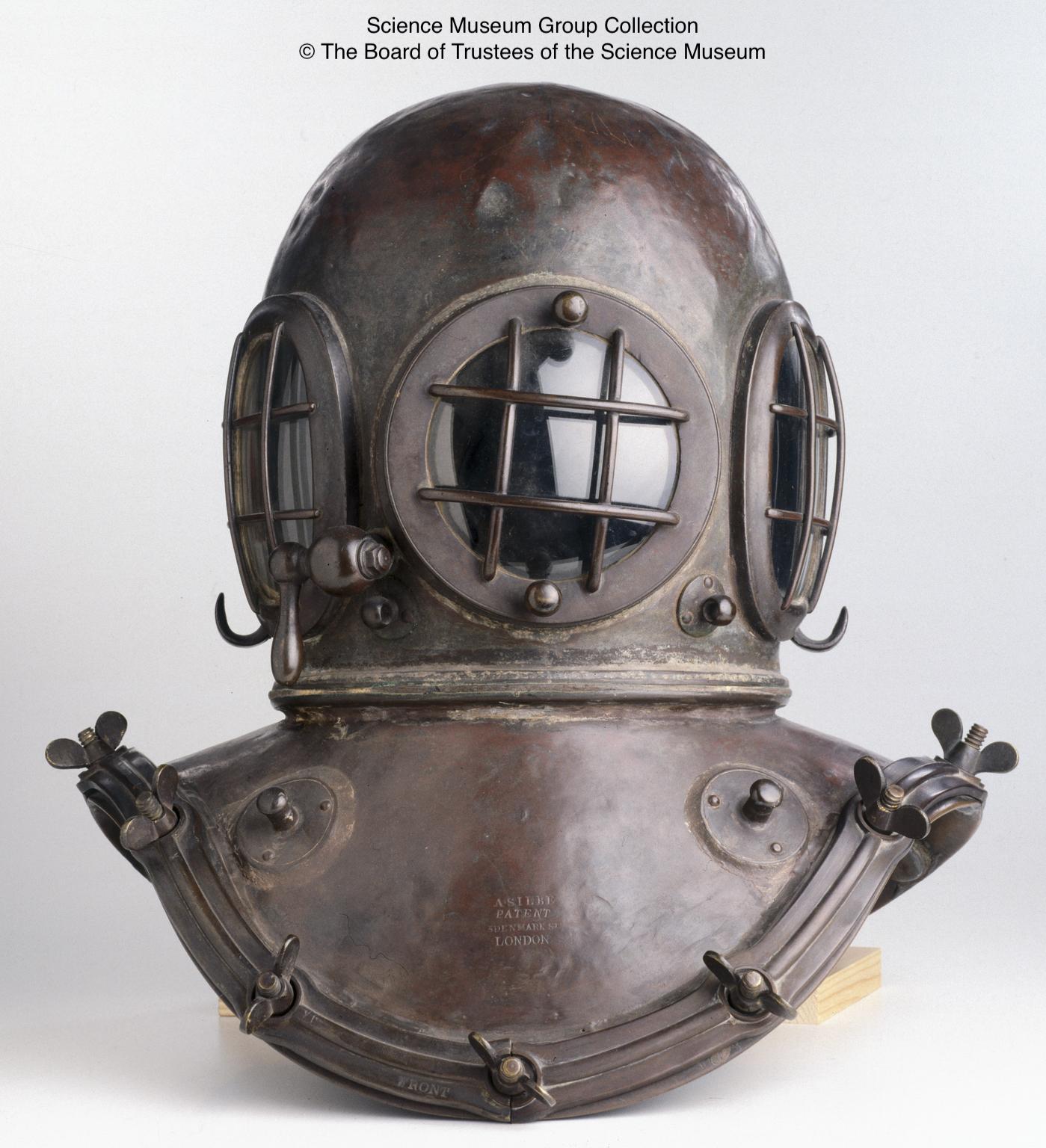
Conceptually, designs descended from the Deane underwater breathing apparatus are still used by deep-sea divers today. Modern dive systems are made with space-age materials, incorporating many safety features, and more often than not, they are supplied with compressed air or gaseous mixes rather than having it pumped by hose. While there are now many options available to a diver depending upon the specific diving requirement, all will ultimately have stemmed from the same Whitstable heritage. Ironically, while current diving equipment may have an obvious lineage direct from that of the Deane brothers’ smoke-hood, modern breathing apparatus used by firefighters can, belatedly, be said to have a shared evolution with that used underwater.
By 1856, divers were still few in number and they went where the work was; it could also be competitive, with construction and salvage work placing demands on their skills. Nonetheless, some larger salvage jobs meant the shared rewards could be sufficiently great to warrant working together or subcontracting to other dive teams. Indeed, diving families were sociable and close, and rivalry was only friendly. Certain pubs in Whitstable became regular places to find divers resting up, waiting for their next job. Intermarriage between their families was not unheard of; however, a lone diver could not work in isolation, as they required a support crew to manage their vessel on the surface and other men to attend the hand-cranked air pumps. These support functions would probably have been worked cooperatively on a large salvage job to avoid tripping over each others' gear and to achieve the salvage objectives safely and efficiently.
The same divers that Nott arranged to salvage the Josephine Willis were mentioned as working together (excepting Parker, who is not mentioned) along with their boats in a newspaper article from August 1855. On this earlier occasion, four dive crews succeeded in working together to raise the wreck of the steam ship Imperatrice, bringing the hull and all of its cargo safely into Ramsgate harbour. The newspaper article reporting this marvelous feat grouped the divers into working boats as follows, but does not mention the ancillary workers or other crew members:
Prosperous cutter of Whitstable, owned by Wallace Bell, with John Brown as master and diver.
Mandamus cutter, owned by Mr. Gann, with W. R. Whorlow as master and diver.
Lord Warden of Whitstable, Mr. Rigden, master, with Norman and John Rigden as divers.
Rose smack of Margate, with Joseph Fruin as master and diver, and George Gardiner as diver.
Within a week of the Josephine Willis disaster, the divers had made their initial inspection of the wreck. She was found to be resting upright on the seabed under about 12 fathoms (22 meters) of water; her topmasts were still visible above the water at low tide. There was a great quantity of broken sails and rigging preventing further examination at that time, but they were optimistic about recovering much of the cargo. Within a month, they had cleared the decks of the broken spars and rigging and had gained access to the main cabins, where they managed to recover quantities of the passengers’ luggage. These personal belongings (at least in the case of the captain’s luggage) were returned to the family without charge for salvage.
As the work progressed, the divers proposed to the owners that it might be possible to raise the ship entirely using chains, as they had previously done successfully with the Imperatrice. This suggested plan of action was never taken up by the vessel owners. Among the passenger cabins' possessions were found 176 gold sovereigns and a case of valuable jewellery.
Not all the gold coins that went down with the ship were recovered by the contemporary divers in 1856. Other gold coins were discovered when the modern-day divers rediscovered the wreck many years later. As is required by law, these coins were passed to the Receiver of Wreck by the divers that found them. Since being entrusted to their care, these coins have mysteriously gone missing. Neither the Receiver of Wreck nor her staff could account for them. Apparently, the police were informed by the subsequent incumbent in the role of Receiver, but no further action was ever taken. They remain missing, presumed stolen.
With the exception of one particularly foul period of poor weather, the salvage operations proceeded for several months. In the May of 1856, a body was discovered in the Steerage accommodation section of the wreck, but it was not identifiable as male or female. It was not retrieved at the time due to the diver not carrying sufficient weight and having to surface. Around this time, it was reported that there had been no accidents involving the divers up until this point in the salvage operation. By July, the divers were raising large quantities of cargo and shipping it weekly from the wreck-site to Dover for public auction for the benefit of the underwriters. Captain Nott had directed local auctioneer Thomas Robinson to act in this regard, and the auctions were well advertised in the local newspapers. The last newspaper report of the divers returning to port with salvage from the Josephine Willis was around the second week of September 1856. Presumably, the weather was turning wintry, and diminishing returns of salvage meant the divers moved on to other, more profitable work elsewhere.
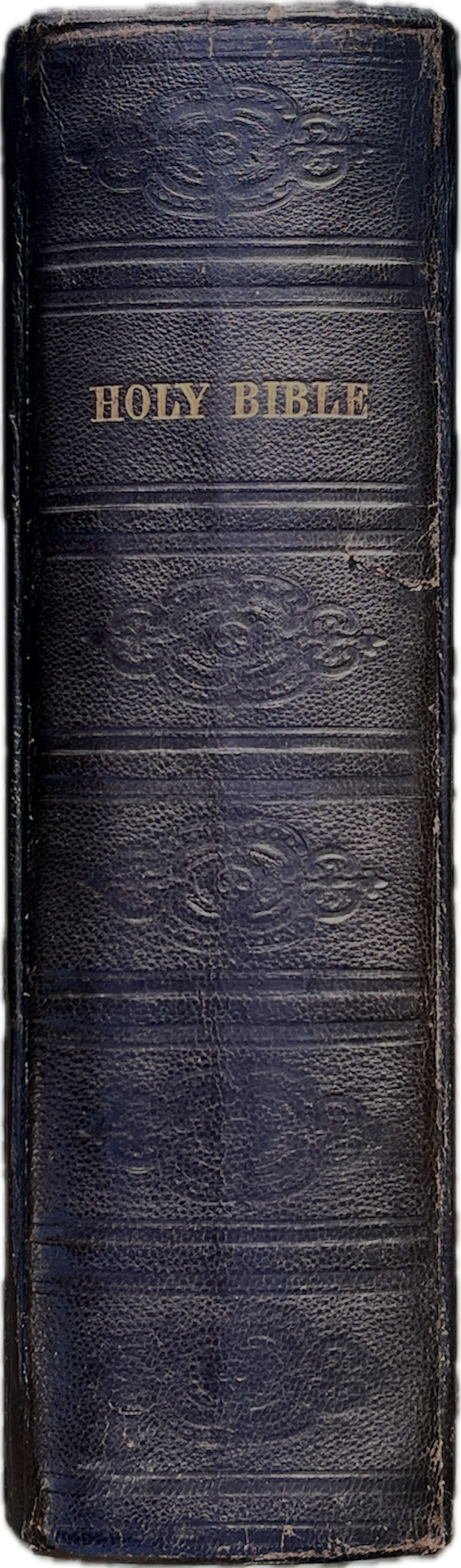
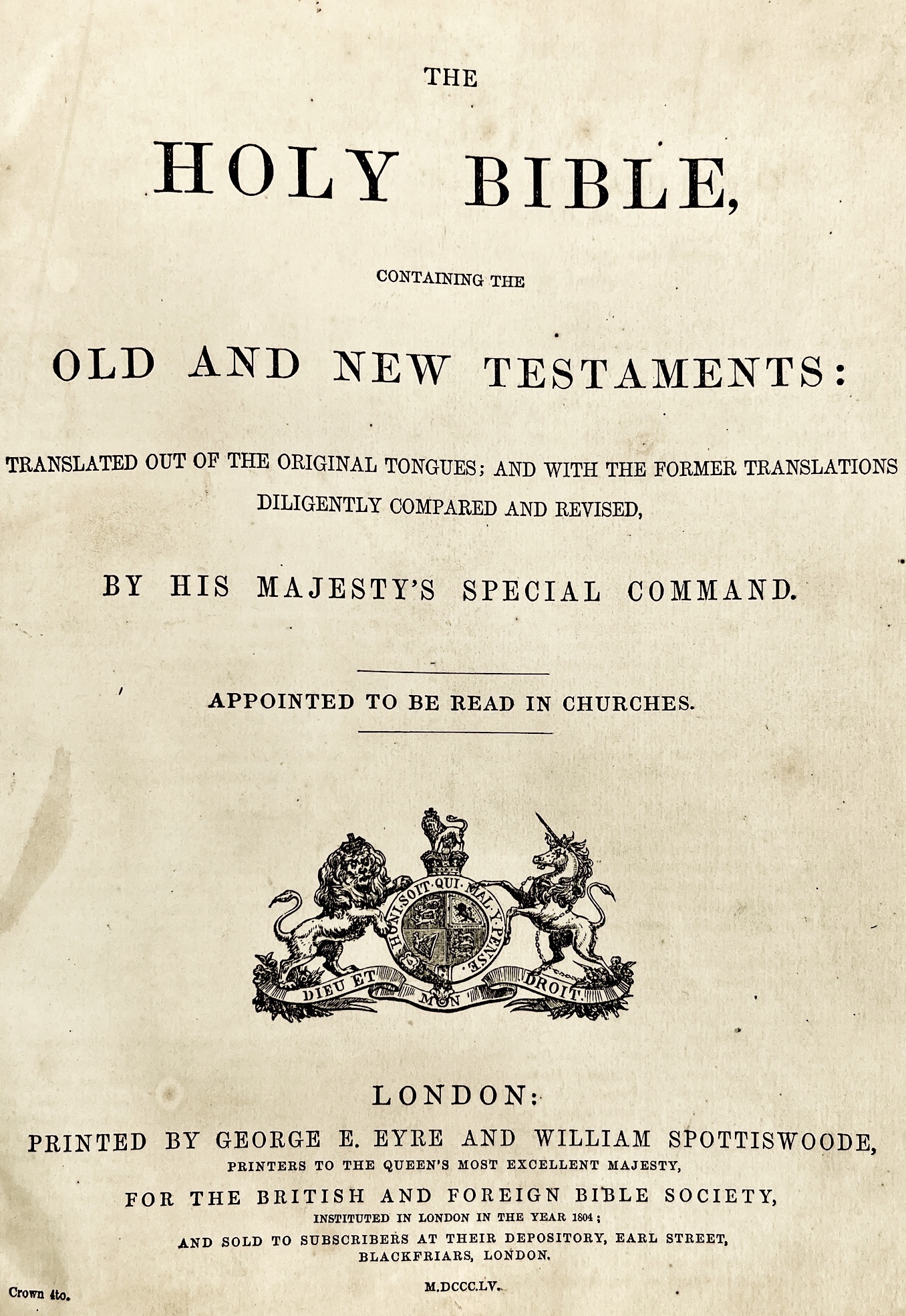
Of all the thousands of individual items salvaged during the 1856 operations, only four extant objects attributed to being raised from the wreck at that time have been found to date. They are three bibles, published in 1855, and one Book of Common Prayer, published in 1854. All four books were published by George E. Eyre and William Spottiswoode for the British and Foreign Bible Society. It seems likely they had been part of a consignment of religious books and tracts being transported by passenger Samuel Hamilton as part of his missionary work to the New Zealand colony. After their retrieval from the deep, the bibles entered into the ownership of local families connected to the sea. All contain similar inscriptions attributing them to the wreck of the Josephine Willis, although the number of souls believed lost varies in the text from 70 to 89. The bibles all carry notes of family births, marriages, and deaths.
Two of the bibles came into the ownership of families that included local seamen based at Deal, the Holness and Wilkins families. These families of Kentish boatmen worked all along the south coast of England at the time that the Josephine Willis was lost. They may well have actually worked alongside the salvage divers; however, links to the diving work have yet to be found at the time of writing.
The Wilkins bible, in addition to the traditional notations of family events, interestingly also records the oaths of three family members making the pledge of temperance in 1892. The third bible is currently in the possession of the writer.
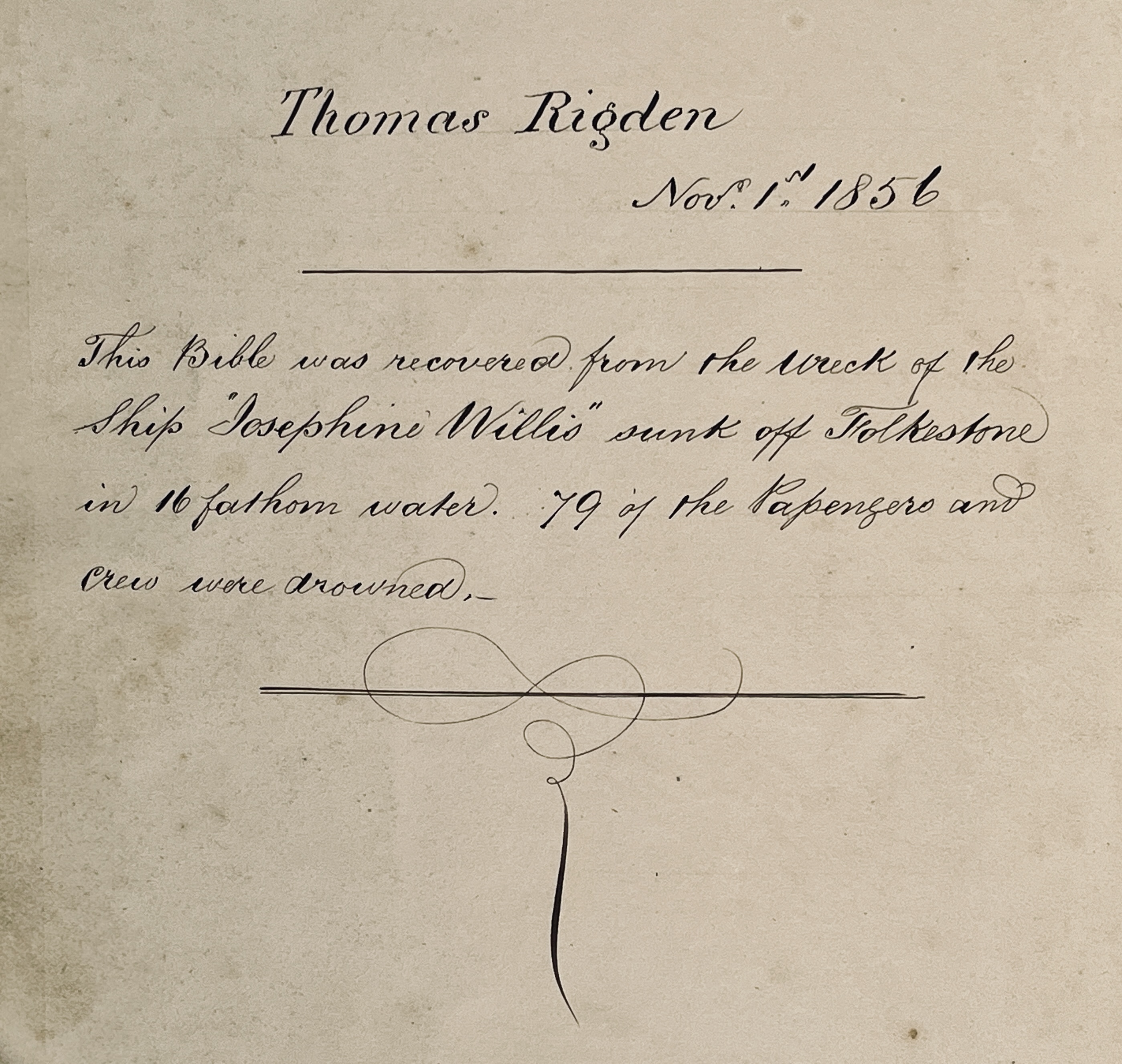
Upon its reclamation from the sea, it became the property of a Thomas Rigden, and there is a handwritten note about the wreck under his name and the date November 1st, 1856. It is not clear which Thomas Rigden this is, but it is probably either the father or brother of the divers Norman and John Rigden. One of these Thomases was the master of the boat Lord Warden of Whitstable that was used during the salvage work; whichever Thomas it was, it most likely came directly into their hands from one of the divers working on the wreck, or they may have done some of the diving themselves.
The book inscriptions show it was subsequently passed on to Amelia Sophia Rigden (sister to Norman and John). She used it to record the usual worldly comings and goings of her own family after she married William Bedwell in 1857. Poignantly, the final entry, in another hand, notes her death in 1906.
The quantities of salvage being brought ashore by the dive crews were initially only notionally mentioned in passing by the newspapers but were later further detailed in listings for specifically dated auctions organised by Robinson. These occurred between the April and July of 1856 and then again later for one-off auctions in 1857 and 1861. It is not clear if this reflects further salvage work being undertaken but the last items to be auctioned appear to be large and or heavy, and in some cases such as the Iron Knees, these were important to the structural integrity of the wreck so could only have been removed last. The newspapers’ lists of items brought ashore for auction are probably not as exhaustive as the also advertised sale catalogues may have been but unfortunately no sale catalogues have been found to confirm this. In all, fourteen auctions have been found advertised in newspapers. Some of the sales were numbered as being the 12th, 13th, and 14th in number associated with the Josephine Willis salvage work, but only twelve auctions have actually been found in the newspapers up until that date. There are two sales subsequent to this “14th sale,” but those are later, separated by considerable time gaps. So it is fair to presume there may have been two further auctions as yet unaccounted for, and therefore more cargo may have existed than is recorded here.
Nonetheless, the numbers of items salvaged and subsequently listed for sale are in the thousands and are incredibly diverse in nature ; the ship carried everything you might need to facilitate the journey and a new life and work in a the colony ; from air beds and cushions, bottled stout, and lead pipe to cartwheels and scythes.
Below are recorded the items as listed for each auction in the Kent newspapers of the day. It is not known if unsold items from any one sale were later carried over to subsequent sales, but following the auction lists below, I include totals for items auctioned off; they are grouped by type or purpose to give an impression of the overall volumes of goods being carried by the ship. These numbers can only be estimates because not all of the cargo was raised, and some values may be overestimates should items have been subsequently re-listed for auction at a later date, and so some things may be double counted. Additionally, some of the original descriptions are not clear as to whether the items are actually like for like between auctions, so please treat the actual numbers with some scepticism.
Bibliography:
Another Whitstable Trade: An illustrated history of helmet diving. John Bevan 2009.
Dover Chronicle, British Newspaper Archive.
Dover Telegraph and Cinque Ports General Advertiser, British Newspaper Archive.
Folkestone Chronicle, British Newspaper Archive.
Kent Herald, British Newspaper Archive.
Kentish Gazette, British Newspaper Archive.
South Eastern Gazette, British Newspaper Archive.
South London Journal, British Newspaper Archive.
The Weekly Dispatch, British Newspaper Archive.
*Acknowledgement: Content provided by THE BRITISH LIBRARY BOARD. ALL RIGHTS RESERVED. With thanks to The British Newspaper Archive (www.britishnewspaperarchive.co.uk)
Salvaged Auction Inventory: Cargo of the Josephine Willis
1. April 16, 1856 (Jewellery & Plate)
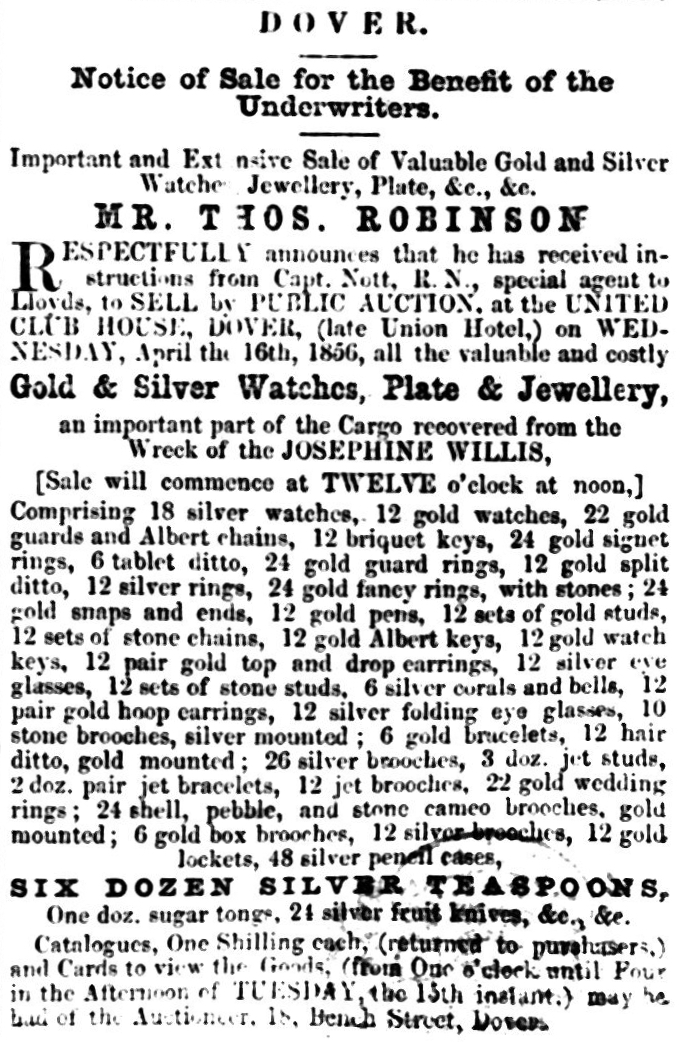
12 April 1856.
British Newspaper Archive*
Location: The United Club House Hotel, Dover
18 silver watches
12 gold watches
22 gold guards and Albert chains
12 briquet keys
24 gold signet rings
6 tablet gold signet rings
24 gold guard rings
12 gold split gold guard rings
24 gold fancy rings, with stones
24 gold snaps and ends
12 gold pens
12 sets of gold studs
12 sets of stone chains
12 gold Albert keys
12 gold watch keys
12 pair gold top and drop earrings
12 silver eye glasses
12 sets of stone studs
6 silver corals and bells
12 pair gold hoop earrings
12 silver folding eye glasses
10 hair stone brooches, silver mounted
6 gold bracelets
12 hair bracelets, gold mounted
26 silver brooches
3 doz. jet studs
2 doz. pair jet bracelets
12 jet brooches
22 gold wedding rings
24 shell, pebble, and stone cameo brooches, gold mounted
6 gold box brooches
12 silver brooches
12 gold lockets
48 silver pencil cases
six dozen silver teaspoons
one doz. sugar tongs
24 silver fruit knives, &c.
2. June 25 & 26, 1856 (Drapery & Clothing)
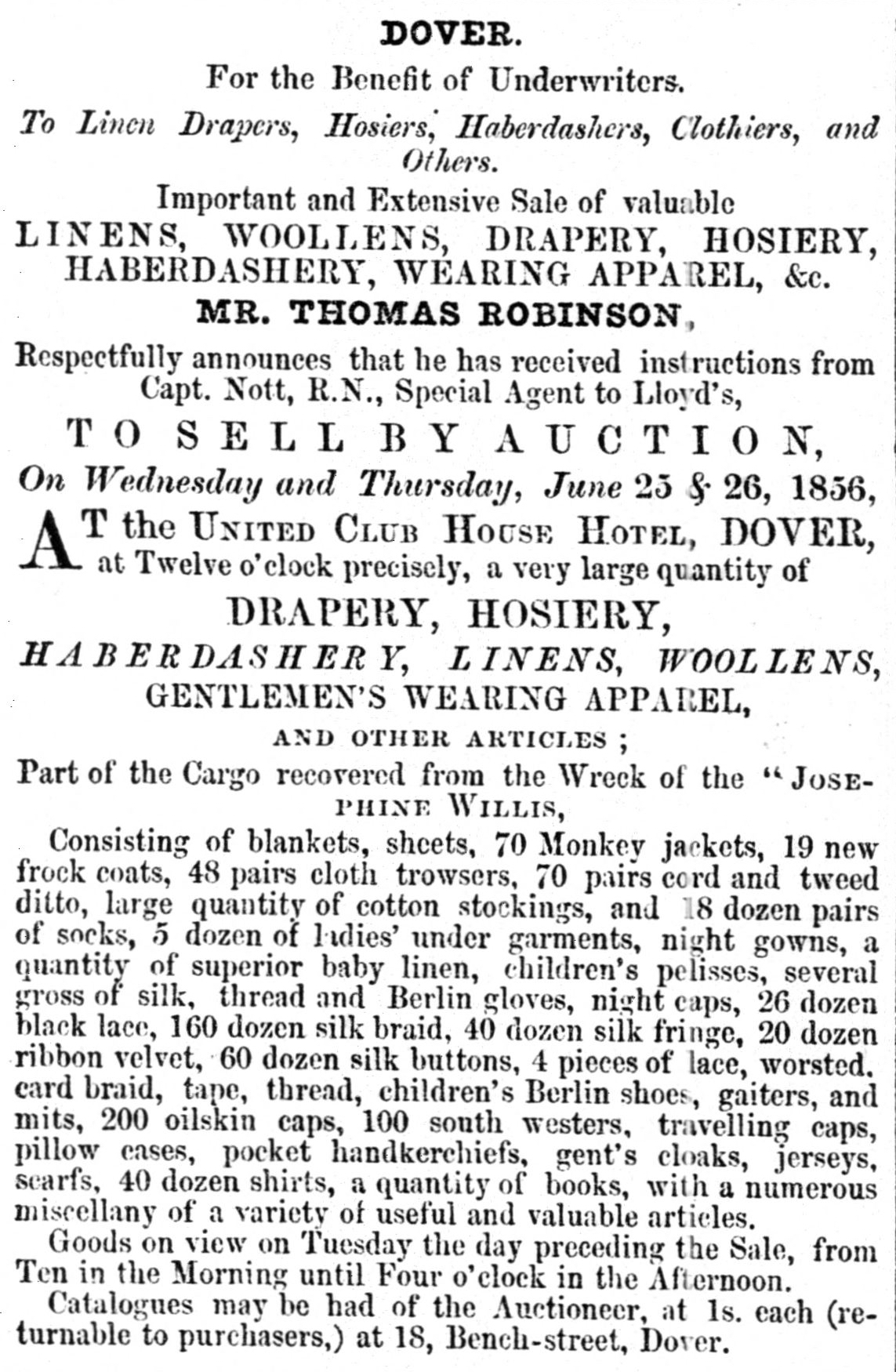
24 June 1856.
British Newspaper Archive*
Location: The United Club House Hotel, Dover
Blankets
Sheets
70 monkey jackets
19 new frock coats
48 pairs cloth trousers
70 pairs cord and tweed cloth trousers
Large quantity of cotton stockings
18 dozen pairs of socks
5 dozen of ladies' under garments
Night gowns
A quantity of superior baby linen
Children's pelisses
Several gross of silk, thread and Berlin gloves
Night caps
26 dozen black lace
160 dozen silk braid
40 dozen silk fringe
20 dozen ribbon velvet
60 dozen silk buttons
4 pieces of lace, worsted, card braid, tape, thread
Children's Berlin shoes, gaiters and mits
200 oilskin caps
100 south westers
Travelling caps
Pillow cases
Pocket handkerchiefs
Gent's cloaks
Jerseys
Scarfs
40 dozen shirts
A quantity of books
A numerous miscellany of a variety of useful and valuable articles
3. July 9 & 10, 1856 (Clothing, Tools & Sundries)
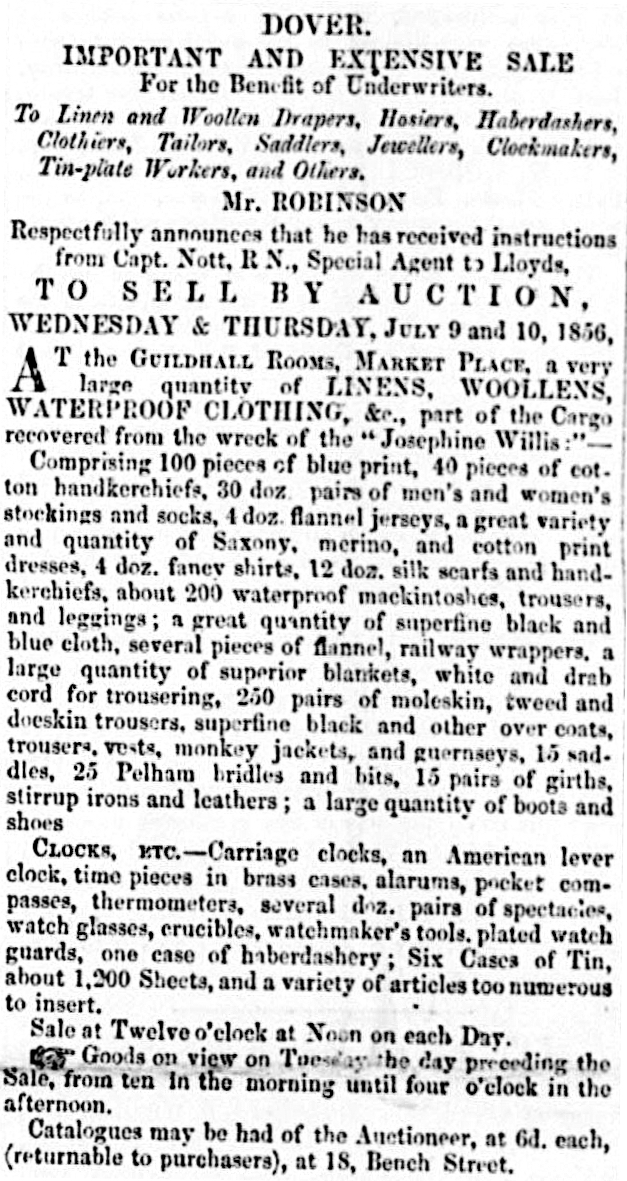
3 July 1856.
British Newspaper Archive*
Location: The Guildhall Rooms, Market Place
100 pieces of blue print
40 pieces of cotton handkerchiefs
30 doz. pairs of men's and women's stockings and socks
4 doz. flannel jerseys
A great variety and quantity of Saxony, merino, and cotton print dresses
4 doz. fancy shirts
12 doz. silk scarfs and handkerchiefs
About 200 waterproof mackintoshes, trousers, and leggings
A great quantity of superfine black and blue cloth
Several pieces of flannel
Railway wrappers
A large quantity of superior blankets, white and drab cord for trousering
250 pairs of moleskin, tweed and doeskin trousers
Superfine black and other over coats
Trousers
Vests
Monkey jackets
Guernseys
15 saddles
25 Pelham bridles and bits
15 pairs of girths, stirrup irons and leathers
A large quantity of boots and shoes
Carriage clocks
An American lever clock
Time pieces in brass cases
Alarums
Pocket compasses
Thermometers
Several doz. pairs of spectacles
Watch glasses
Crucibles
Watchmaker's tools
Plated watch guards
One case of haberdashery
Six cases of tin, about 1,200 sheets
A variety of articles too numerous to insert.
4. July 21 & 22, 1856 (Drapery & Clothing)
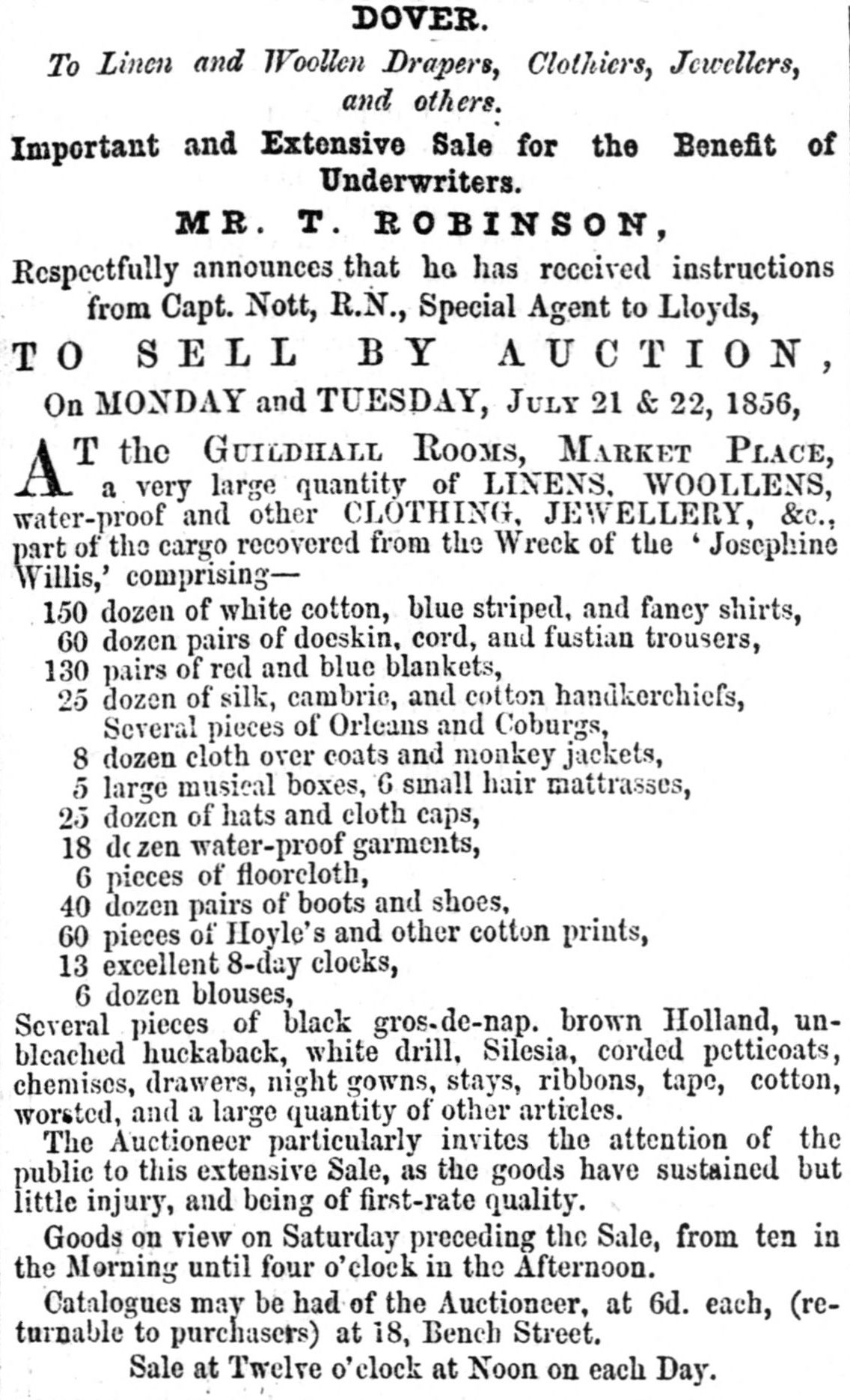
15 July 1856.
British Newspaper Archive*
Location: The Guildhall Rooms, Market Place
150 dozen of white cotton, blue striped, and fancy shirts
60 dozen pairs of doeskin, cord, and fustian trousers
130 pairs of red and blue blankets
25 dozen of silk, cambric, and cotton handkerchiefs
Several pieces of Orleans and Coburgs
8 dozen cloth over coats and monkey jackets
5 large musical boxes
6 small hair mattresses
25 dozen of hats and cloth caps
18 dozen water-proof garments
6 pieces of floorcloth
40 dozen pairs of boots and shoes
60 pieces of Hoyle's and other cotton prints
13 excellent 8-day clocks
6 dozen blouses
Several pieces of black gros-de-nap, brown Holland, unbleached huckaback, white drill, Silesia, corded petticoats, chemises, drawers, night gowns, stays, ribbons, tape, cotton, worsted, and a large quantity of other articles.
5. July 29, 1856 (Provisions, Furniture & Ironmongery)
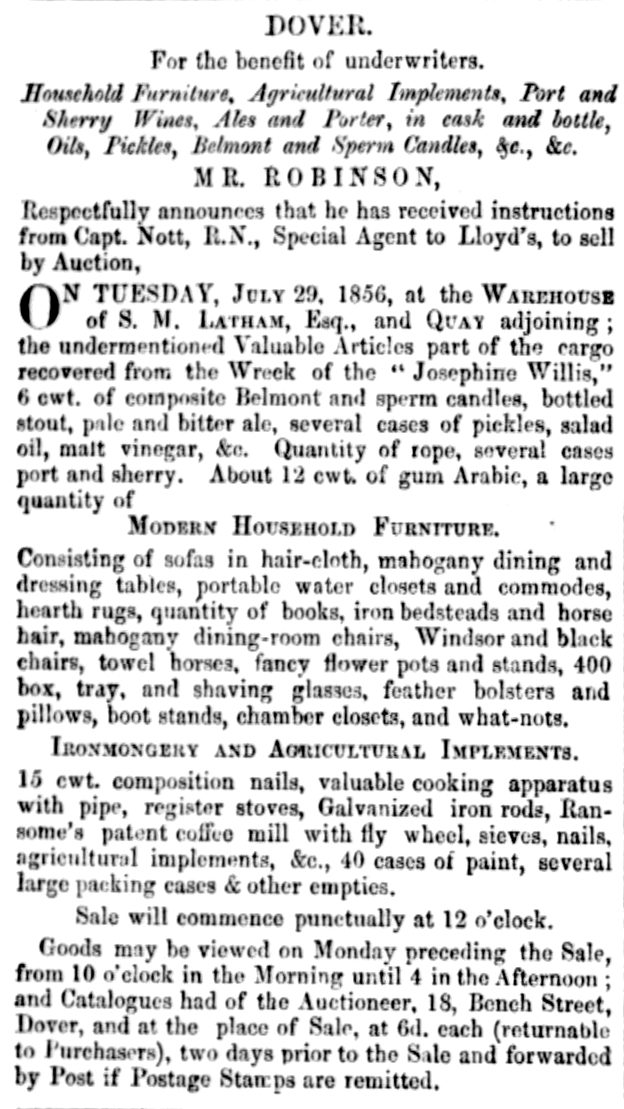
24 July 1856.
British Newspaper Archive*
Location: The Warehouse of S. M. Latham, Esq., and Quay adjoining
Port and sherry wines
Ales and porter, in cask and bottle
Oils
Pickles
6 cwt. of composite Belmont and sperm candles
Bottled stout
Pale and bitter ale
Several cases of pickles
Salad oil
Malt vinegar
Quantity of rope
Several cases port and sherry
About 12 cwt. of gum Arabic
A large quantity of modern household furniture (Consisting of sofas in hair-cloth, mahogany dining and dressing tables, portable water closets and commodes, hearth rugs, quantity of books, iron bedsteads and horse hair, mahogany dining-room chairs, Windsor and black chairs, towel horses, fancy flower pots and stands, 400 box, tray, and shaving glasses, feather bolsters and pillows, boot stands, chamber closets, and what-nots)
Ironmongery and agricultural implements (15 cwt. composition nails, valuable cooking apparatus with pipe, register stoves, galvanized iron rods, Ran-some's patent coffee mill with fly wheel, sieves, nails, agricultural implements, &c., 40 cases of paint, several large packing cases & other empties)
6. August 12 & 13, 1856 (Clothing & Sundries)
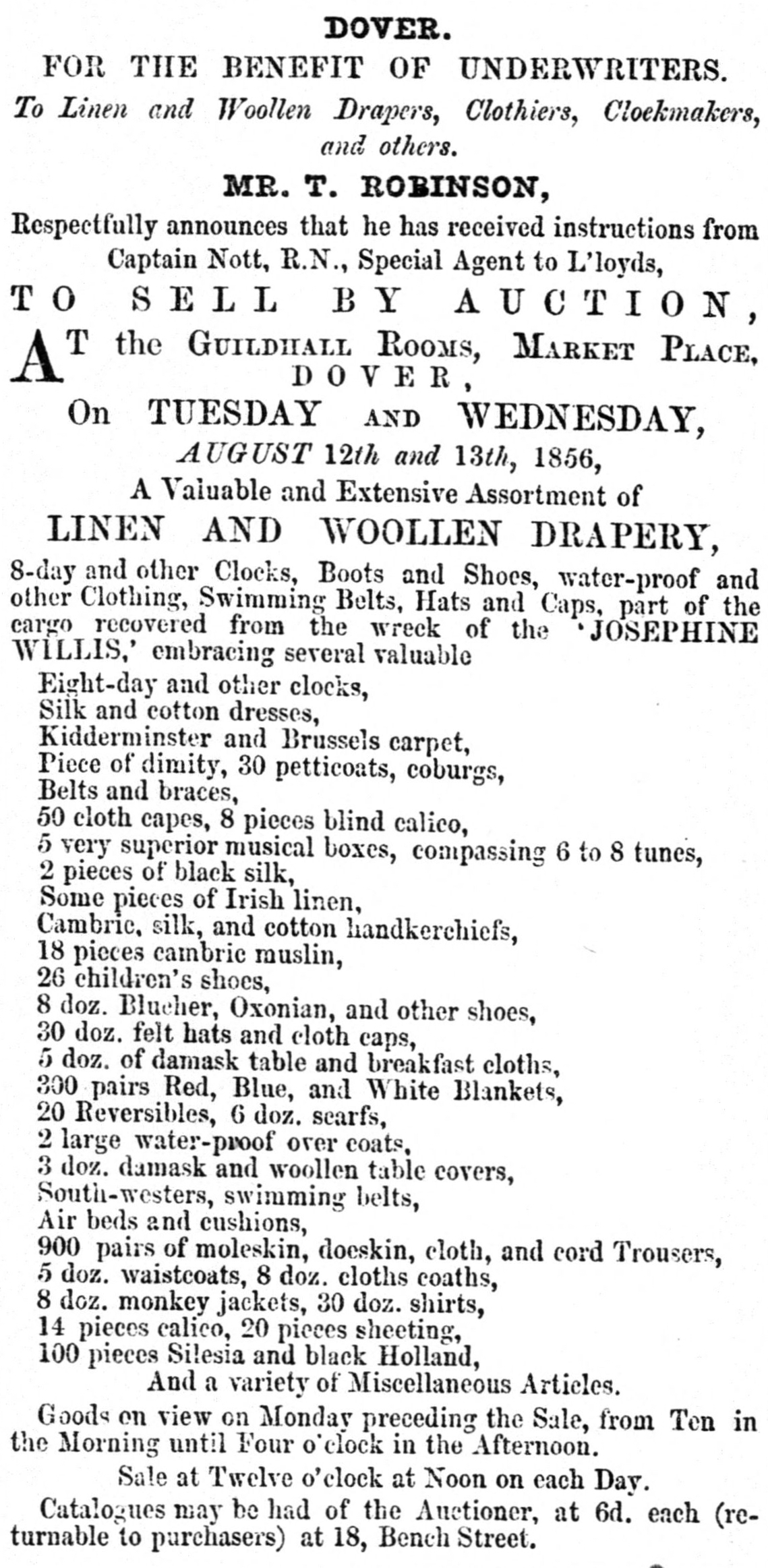
5 August 1856.
British Newspaper Archive*
Location: The Guildhall Rooms, Market Place, Dover
8-day and other clocks
Boots and shoes
Water-proof and other clothing
Swimming belts
Hats and caps
Silk and cotton dresses
Kidderminster and Brussels carpet
Piece of dimity
30 petticoats
Coburgs
Belts and braces
50 cloth caps
8 pieces blind calico
5 very superior musical boxes, compassing 6 to 8 tunes
2 pieces of black silk
Some pieces of Irish linen, cambric, silk, and cotton handkerchiefs
18 pieces cambric muslin
26 children's shoes
8 doz. Blucher, Oxonian, and other shoes
30 doz. felt hats and cloth caps
5 doz. of damask table and breakfast cloths
300 pairs red, blue, and white blankets
20 Reversibles
6 doz. scarfs
2 large water-proof over coats
3 doz. damask and woollen table covers
South-westers
Swimming belts
Air beds and cushions
900 pairs of moleskin, doeskin, cloth, and cord trousers
5 doz. waistcoats
8 doz. cloths coats
8 doz. monkey jackets
30 doz. shirts
14 pieces calico
20 pieces sheeting
100 pieces Silesia and black Holland
A variety of miscellaneous articles
7. August 21, 1856 (Provisions, Tools & Sundries)
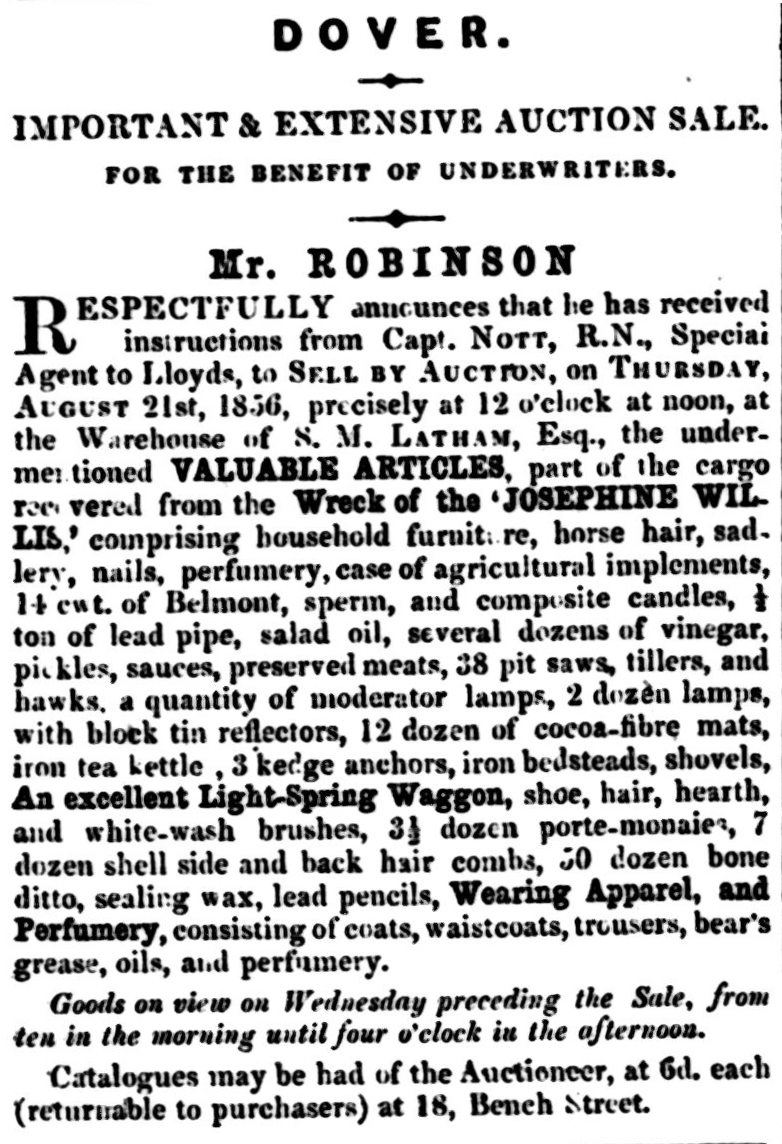
16 Aug 1856.
British Newspaper Archive*
Location: Warehouse of S. M. Latham, Esq.
Household furniture
Horse hair
Saddlery
Nails
Perfumery
Case of agricultural implements
14 cwt. of Belmont, sperm and composite candles
1/2 ton of lead pipe
Salad oil
Several dozens of vinegar, pickles, sauces, preserved meats
38 pit saws
Tillers and hawks
A quantity of moderator lamps
2 dozen lamps, with block tin reflectors
12 dozen of cocoa-fibre mats
Iron tea kettle
3 kedge anchors
Iron bedsteads
Shovels
An excellent Light-Spring waggon
Shoe, hair, hearth, and white-wash brushes
3 1/2 dozen porte-monaie
7 dozen shell side and back hair combs
50 dozen bone hair combs
Sealing wax
Lead pencils
Wearing apparel and perfumery (coats, waistcoats, trousers, bear's grease, oils, and perfumery)
8. August 27 & 28, 1856 (Drapery & Clothing)
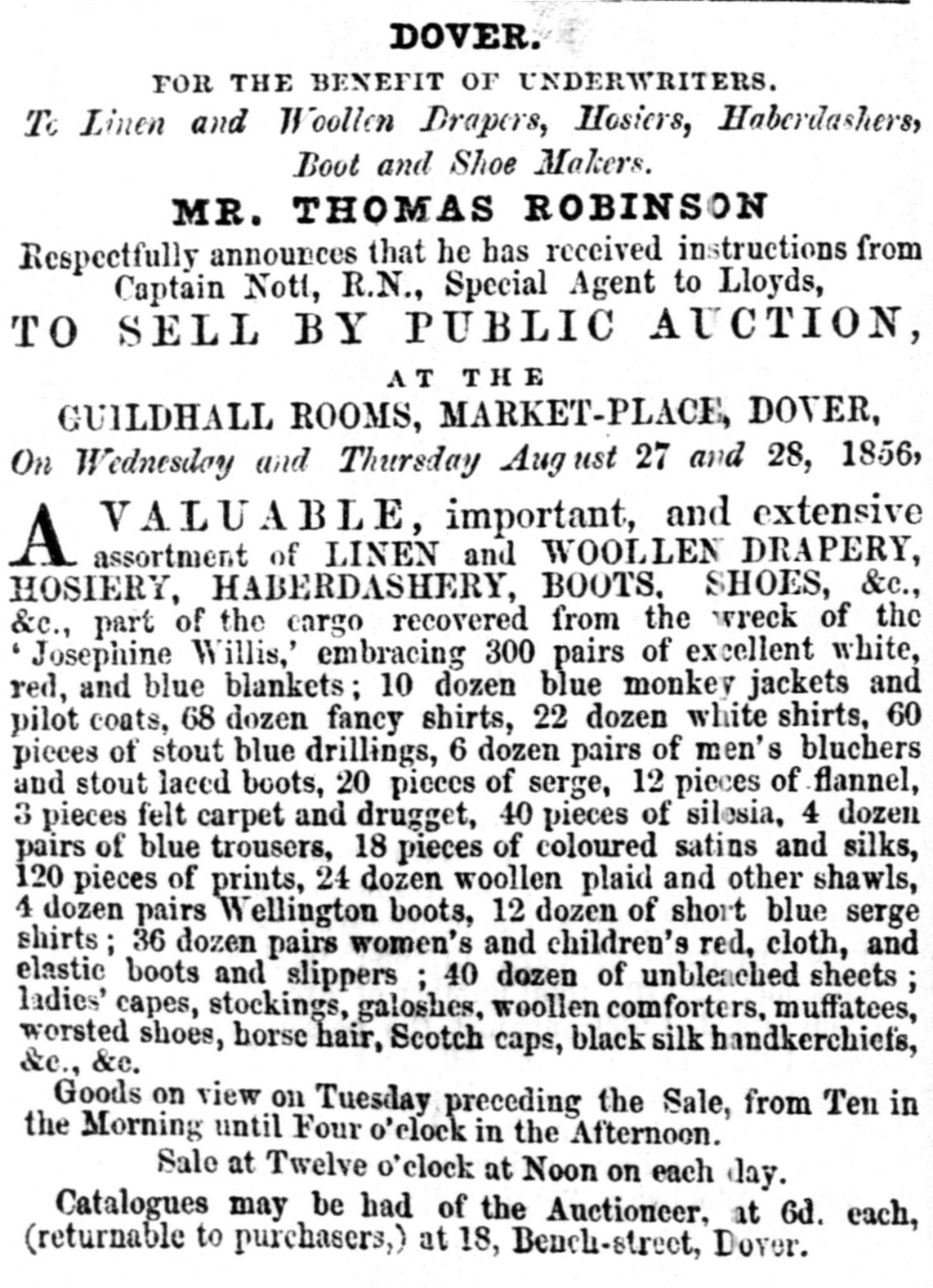
28 Aug 1856.
British Newspaper Archive*
Location: Guildhall Rooms, Market-Place, Dover
300 pairs of excellent white, red, and blue blankets
10 dozen blue monkey jackets and pilot coats
68 dozen fancy shirts
22 dozen white shirts
60 pieces of stout blue drillings
6 dozen pairs of men's bluchers and stout laced boots
20 pieces of serge
12 pieces of flannel
3 pieces felt carpet and drugget
40 pieces of Silesia
4 dozen pairs of blue trousers
18 pieces of coloured satins and silks
120 pieces of prints
24 dozen woollen plaid and other shawls
4 dozen pairs Wellington boots
12 dozen of short blue serge shirts
36 dozen pairs women's and children's red, cloth, and elastic boots and slippers
40 dozen of unbleached sheets
Ladies' capes
Stockings
Galoshes
Woollen comforters
Muffatees
Worsted shoes
Horse hair
Scotch caps
Black silk handkerchiefs
9. September 10 & 11, 1856 (Drapery & Clothing)
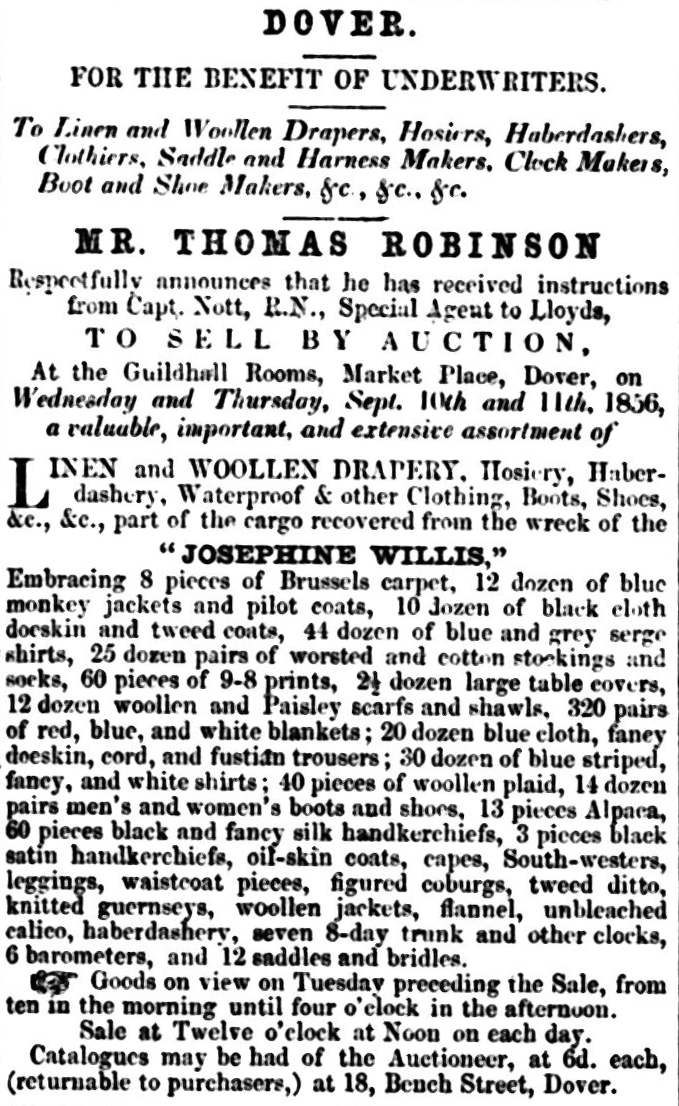
6 September 1856.
British Newspaper Archive*
Location: Guildhall Rooms, Market Place, Dover
8 pieces of Brussels carpet
12 dozen of blue monkey jackets and pilot coats
10 dozen of black cloth doeskin and tweed coats
44 dozen of blue and grey serge shirts
25 dozen pairs of worsted and cotton stockings and socks
60 pieces of 9-8 prints
2 1/2 dozen large table covers
12 dozen woollen and Paisley scarfs and shawls
320 pairs of red, blue, and white blankets
20 dozen blue cloth, fancy doeskin, cord, and fustian trousers
30 dozen of blue striped, fancy, and white shirts
40 pieces of woollen plaid
14 dozen pairs men's and women's boots and shoes
13 pieces Alpaca
60 pieces black and fancy silk handkerchiefs
3 pieces black satin handkerchiefs
Oil-skin coats
Capes
South-westers
Leggings
Waistcoat pieces
Figured coburgs
Tweed coburgs
Knitted guernseys
Woollen jackets
Flannel
Unbleached calico
Haberdashery
Seven 8-day trunk and other clocks
6 barometers
12 saddles and bridles
10. September 23 & 24, 1856 (12th Sale)
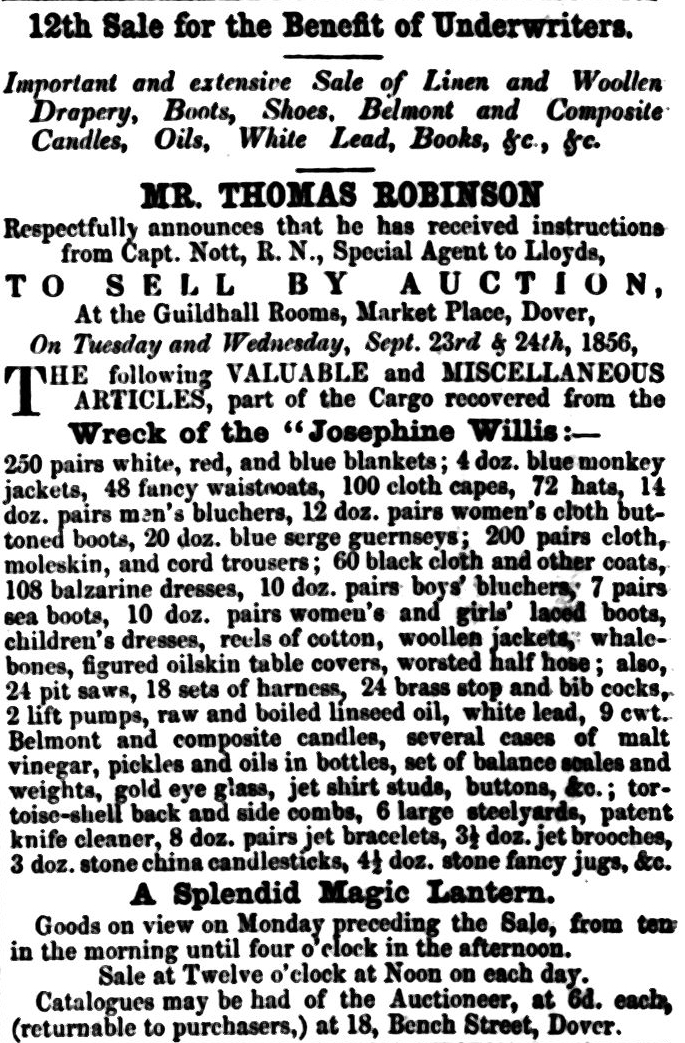
20 September 1856.
British Newspaper Archive*
Location: Guildhall Rooms, Market Place, Dover
250 pairs white, red, and blue blankets
4 doz. blue monkey jackets
48 fancy waistcoats
100 cloth capes
72 hats
14 doz. pairs men's bluchers
12 doz. pairs women's cloth buttoned boots
20 doz. blue serge guernseys
200 pairs cloth, moleskin, and cord trousers
60 black cloth and other coats
108 balzarine dresses
10 doz. pairs boys' bluchers
7 pairs sea boots
10 doz. pairs women's and girls' laced boots
Children's dresses
Reels of cotton
Woollen jackets
Whale-bones
Figured oilskin table covers
Worsted half hose
24 pit saws
18 sets of harness
24 brass stop and bib cocks
2 lift pumps
Raw and boiled linseed oil
White lead
9 cwt. Belmont and composite candles
Several cases of malt vinegar
Pickles and oils in bottles
Set of balance scales and weights
Gold eye glass
Jet shirt studs
Buttons, &c. &c.
Tortoise-shell back and side combs
6 large steelyards
Patent knife cleaner
8 doz. pairs jet bracelets
3 1/2 doz. jet brooches
3 doz. stone china candlesticks
4 1/2 doz. stone fancy jugs, &c.
A splendid magic lantern
11. October 22 & 23, 1856 (13th Sale)
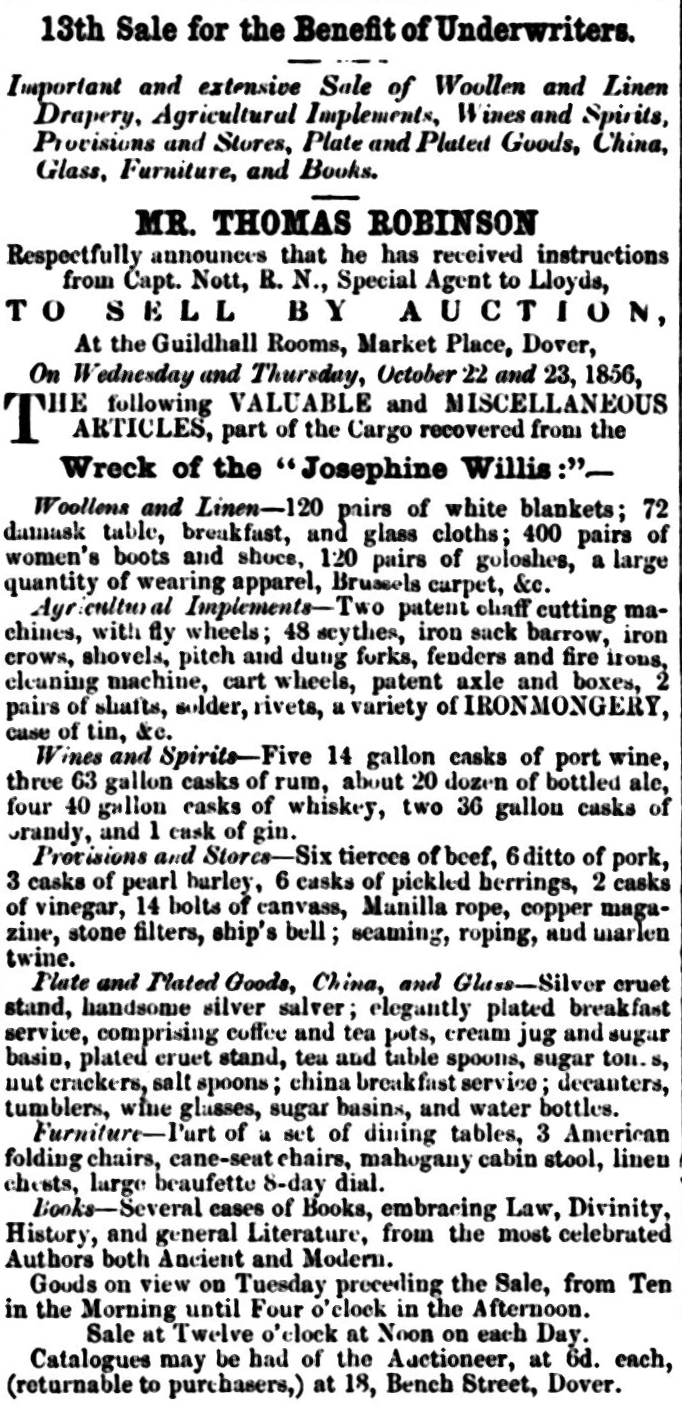
18 October 1856.
British Newspaper Archive*
Location: The Guildhall Rooms, Market Place, Dover
120 pairs of white blankets
72 damask table, breakfast, and glass cloths
400 pairs of women's boots and shoes
120 pairs of galoshes
A large quantity of wearing apparel
Brussels carpet
Two patent chaff cutting machines, with fly wheels
48 scythes
Iron sack barrow
Iron crows
Shovels
Pitch and dung forks
Fenders and fire irons
Cleaning machine
Cart wheels
Patent axle and boxes
2 pairs of shafts
Solder
Rivets
A variety of ironmongery
Case of tin, &c.
Five 14 gallon casks of port wine
Three 63 gallon casks of rum
About 20 dozen of bottled ale
Four 40 gallon casks of whiskey
Two 36 gallon casks of brandy
1 cask of gin
Six tierces of beef
Six tierces of pork
3 casks of pearl barley
6 casks of pickled herrings
2 casks of vinegar
14 bolts of canvass
Manila rope
Copper magazine
Stone filters
Ship's bell
Seaming, roping, and marlen twine [marline twine]
Silver cruet stand
Handsome silver salver
Elegantly plated breakfast service, comprising coffee and tea pots, cream jug and sugar basin
Plated cruet stand
Tea and table spoons
Sugar tongs
Nut crackers
Salt spoons
China breakfast service
Decanters
Tumblers
Wine glasses
Sugar basins
Water bottles
Part of a set of dining tables
3 American folding chairs
Cane-seat chairs
Mahogany cabin stool
Linen chests
Large beaufette
8-day dial
Several cases of books, embracing law, divinity, history, and general literature
12. October 31, 1856 (14th Sale)
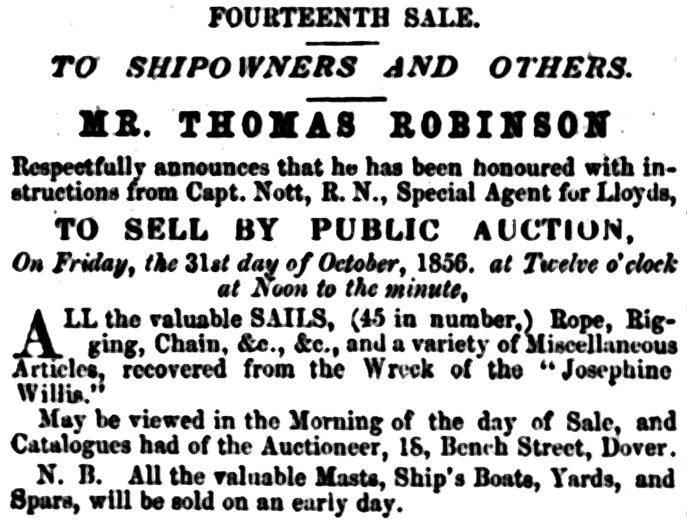
25 October 1856.
British Newspaper Archive*
Location: Dover (Mr. Thomas Robinson's Auction)
All the valuable sails (45 in number)
Rope
Rigging
Chain, &c. &c.
A variety of miscellaneous articles (Note: Masts, Ship's Boats, Yards, and Spars were to be sold on an early day.)
13. January 5 & 6, 1857
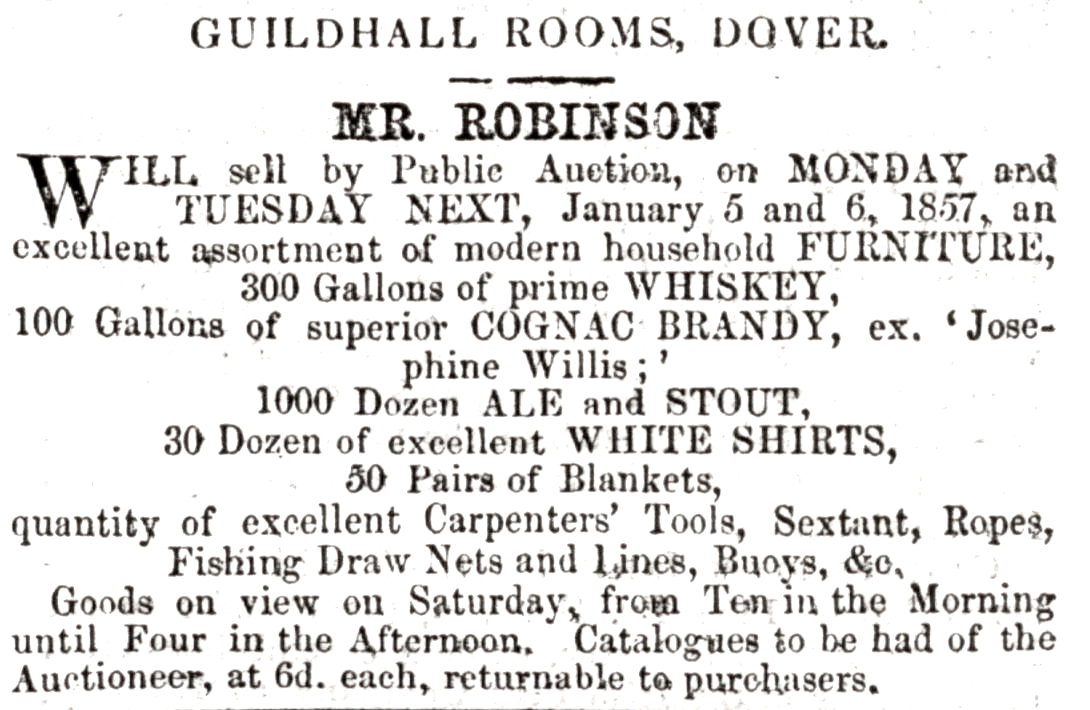
3 January 1857.
British Newspaper Archive*
Location: Guildhall Rooms, Dover
Excellent assortment of modern household furniture
300 gallons of prime whiskey
100 gallons of superior cognac brandy, ex. 'Josephine Willis'
1000 dozen ale and stout
30 dozen of excellent white shirts
50 pairs of blankets
Quantity of excellent carpenters' tools
Sextant
Ropes
Fishing draw nets and lines
Buoys, &c. &c.
14. July 8, 1861 (Final Recorded Sale)
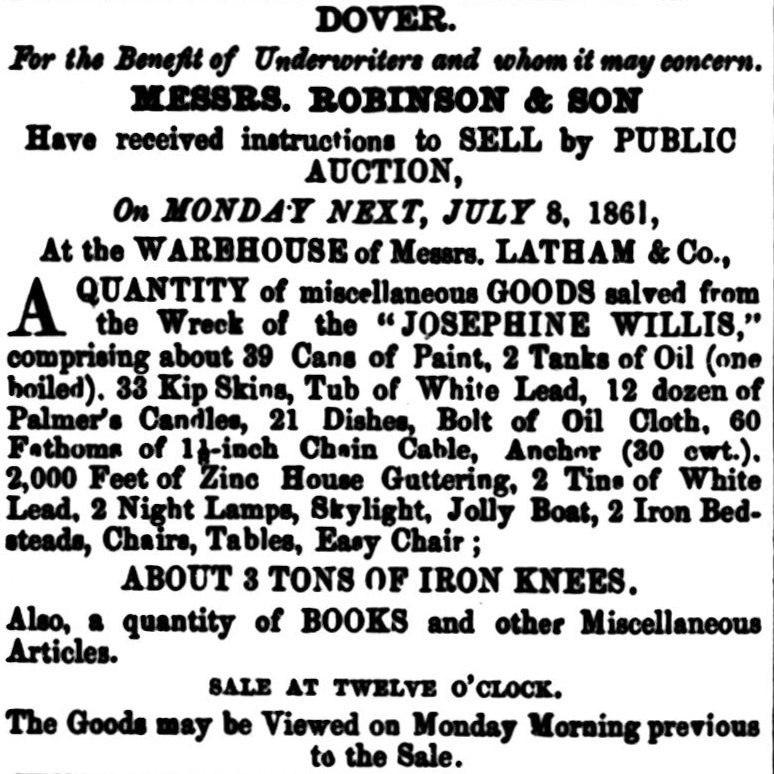
6 July 1861.
British Newspaper Archive*
Location: The Warehouse of Messrs. Latham & Co.
About 39 cans of paint
2 tanks of oil (one boiled)
33 kip skins
Tub of white lead
12 dozen of Palmer's candles
21 dishes
Bolt of oil cloth
60 fathoms of 1 1/8-inch chain cable
Anchor (30 cwt.)
2,000 feet of zinc house guttering
2 tins of white lead
2 night lamps
Skylight
Jolly boat
2 iron bedsteads
Chairs
Tables
Easy chair
About 3 tons of iron knees
A quantity of books and other miscellaneous articles
Master Inventory: Salvaged Cargo of the Josephine Willis
Jewellery & Adornment 18 silver watches; 12 gold watches; 22 gold guards and Albert chains; 12 briquet keys; 24 gold signet rings; 6 tablet gold signet rings; 24 gold guard rings; 12 gold split gold guard rings; 24 gold fancy rings, with stones; 24 gold snaps and ends; 12 gold pens; 12 sets of gold studs; 12 sets of stone chains; 12 gold Albert keys; 12 gold watch keys; 12 pair gold top and drop earrings; 12 silver eye glasses; 12 sets of stone studs; 6 silver corals and bells; 12 pair gold hoop earrings; 12 silver folding eye glasses; 10 hair stone brooches, silver mounted; 6 gold bracelets; 12 hair bracelets, gold mounted; 26 silver brooches; 12 silver brooches; 3 doz. jet studs; 2 doz. pair jet bracelets; 8 doz. pairs jet bracelets; 12 jet brooches; 3 1/2 doz. jet brooches; 22 gold wedding rings; 24 shell, pebble, and stone cameo brooches, gold mounted; 6 gold box brooches; 12 gold lockets; 48 silver pencil cases; six dozen silver teaspoons; one doz. sugar tongs; 24 silver fruit knives, &c.; gold eye glass; jet shirt studs; plated watch guards.
Literature & Stationery A quantity of books; Quantity of books; Several cases of books, embracing law, divinity, history, and general literature; A quantity of books and other miscellaneous articles; sealing wax; lead pencils.
Heavy Outerwear & Coats 70 monkey jackets; monkey jackets; 8 dozen monkey jackets; 8 doz. monkey jackets; 10 dozen blue monkey jackets; 12 dozen of blue monkey jackets; 4 doz. blue monkey jackets; 19 new frock coats; 8 dozen cloth over coats; 8 doz. cloths coats; 10 dozen of black cloth doeskin and tweed coats; 60 black cloth and other coats; superfine black and other over coats; 20 reversibles; 2 large water-proof over coats; oil-skin coats; gent's cloaks; woollen jackets; pilot coats.
Shirts, Guernseys & Hosiery 40 dozen shirts; 150 dozen of white cotton, blue striped, and fancy shirts; 30 doz. shirts; 68 dozen fancy shirts; 22 dozen white shirts; 30 dozen of blue striped, fancy, and white shirts; 30 dozen of excellent white shirts; 4 doz. fancy shirts; 12 dozen of short blue serge shirts; 44 dozen of blue and grey serge shirts; 20 doz. blue serge guernseys; 4 doz. flannel jerseys; guernseys; knitted guernseys; 6 dozen blouses; large quantity of cotton stockings; 18 dozen pairs of socks; 30 doz. pairs of men's and women's stockings and socks; 25 dozen pairs of worsted and cotton stockings and socks; stockings; worsted half hose.
Trousers, Waistcoats & Vests 48 pairs cloth trousers; 70 pairs cord and tweed cloth trousers; 250 pairs of moleskin, tweed and doeskin trousers; 60 dozen pairs of doeskin, cord, and fustian trousers; 900 pairs of moleskin, doeskin, cloth, and cord trousers; 4 dozen pairs of blue trousers; 20 dozen blue cloth, fancy doeskin, cord, and fustian trousers; 200 pairs cloth, moleskin, and cord trousers; white and drab cord for trousering; Trousers; 5 doz. waistcoats; 48 fancy waistcoats; Vests; Waistcoat pieces.
Footwear 480 pairs of boots and shoes; large quantity of boots and shoes; 144 pairs; 400 pairs of women's boots and shoes; 26 children's shoes; 8 doz. Blucher, Oxonian, and other shoes; 6 dozen pairs of men's bluchers and stout laced boots; 14 doz. pairs men's Bluchers; 12 doz. pairs women's cloth buttoned boots; 4 dozen pairs Wellington boots; 36 dozen pairs women's and children's red, cloth, and elastic boots and slippers; 10 doz. pairs boys' bluchers; 7 pairs sea boots; 10 doz. pairs women's and girls' laced boots; 120 pairs of galoshes; galoshes; worsted shoes; children's Berlin shoes, gaiters and mits.
Undergarments & Bedding 300 pairs red, blue, and white blankets; 300 pairs of excellent white, red, and blue blankets; 320 pairs of red, blue, and white blankets; 250 pairs white, red, and blue blankets; 130 pairs of red and blue blankets; 120 pairs of white blankets; 50 pairs of blankets; 5 dozen of ladies' under garments; night gowns; night caps; 30 petticoats; corded petticoats, chemises, drawers, and stays; 40 dozen of unbleached sheets; 20 pieces sheeting; pillow cases; 6 small hair mattresses; feather bolsters and pillows; air beds and cushions; a quantity of superior baby linen; children's pelisses.
Piece Goods & Textiles 100 pieces of blue print; 60 pieces of Hoyle's and other cotton prints; 120 pieces of prints; 60 pieces of 9-8 prints; 108 balzarine dresses; 100 pieces Silesia and black Holland; 40 pieces of Silesia; 60 pieces of stout blue drillings; 20 pieces of serge; 18 pieces cambric muslin; 14 pieces calico; 8 pieces blind calico; 2 pieces of black silk; 18 pieces of coloured satins and silks; 60 pieces black and fancy silk handkerchiefs; 3 pieces black satin handkerchiefs; 13 pieces Alpaca; Saxony, merino, and cotton print dresses; flannel; Brussels carpet; 6 pieces of floorcloth; bolt of oil cloth; 5 doz. of damask table and breakfast cloths; 72 damask table, breakfast, and glass cloths; 3 doz. damask and woollen table covers; 2 1/2 dozen large table covers; 6 doz. scarfs; 12 dozen woollen and paisley scarfs and shawls; 24 dozen woollen plaid and other shawls; handkerchiefs.
Haberdashery & Personal Care 160 dozen silk braid; 40 dozen silk fringe; 20 dozen ribbon velvet; 60 dozen silk buttons; 26 dozen black lace; several gross of silk, thread and Berlin gloves; 4 pieces of lace, worsted, card braid, tape, thread; 7 dozen shell side and back hair combs; 50 dozen bone hair combs; 3 1/2 dozen porte-monaie; 12 dozen of cocoa-fibre mats; 25 dozen of hats and cloth caps; 30 doz. felt hats and cloth caps; 50 cloth caps; 72 hats; 100 cloth capes; 200 oilskin caps; 200 waterproof mackintoshes, trousers, and leggings; 18 dozen water-proof garments; case of haberdashery; reels of cotton; whale-bones; perfumery and bear's grease; shoe, hair, hearth, and white-wash brushes.
Alcohol & Provisions 1000 dozen ale and stout; 20 dozen of bottled ale; 300 gallons of prime whiskey; Four 40 gallon casks of whiskey; 100 gallons of superior cognac brandy; Two 36 gallon casks of brandy; Five 14 gallon casks of port wine; Three 63 gallon casks of rum; 1 cask of gin; 6 tierces of beef; 6 tierces of pork; 3 casks of pearl barley; 6 casks of pickled herrings; port and sherry wines; vinegar; pickles and sauces.
Household Furniture & Domestic 400 box, tray, and shaving glasses; 3 American folding chairs; Sofas in hair-cloth; mahogany dining and dressing tables; portable water closets and commodes; Iron bedsteads; Mahogany dining-room chairs; Windsor and black chairs; towel horses; boot stands; what-nots; mahogany cabin stool; cane-seat chairs; linen chests; large beaufette; easy chair; chamber closets; cancy flower pots and stands; 21 dishes; China and plated breakfast services; silver and plated cruet stands; decanters, tumblers, and wine glasses; 4 1/2 doz. stone fancy jugs; 3 doz. stone china candlesticks; magic lantern; patent knife cleaner; Iron tea kettle; 2 night lamps; moderator lamps; 2 dozen lamps with block tin reflectors; Ransome's patent coffee mill.
Hardware & Mechanical Tools 15 cwt. composition nails; cooking apparatus with pipe; register stoves; galvanized iron rods; 24 brass stop and bib cocks; 2 lift pumps; fenders and fire irons; cleaning machine; solder and rivets; crucibles; watchmaker's tools; carpenter's tools.
Instruments & Precision Tools 13 excellent 8-day clocks; 7 8-day trunk and other clocks; 8-day dial; American lever clock; carriage clocks; iime pieces in brass cases; alarums; 6 barometers; 1 sextant; 10 musical boxes (5; 5); 62 pit saws (38; 24); pocket compasses and thermometers; spectacles; 6 large steelyards; balance scales and weights.
Saddlery, Agriculture & Tools 15 saddles; 12 saddles; 25 Pelham bridles and bits; 12 bridles; 15 pairs of girths, stirrup irons and leathers; 18 sets of harness; saddlery; agricultural implements; 2 patent chaff cutting machines, with fly wheels; 48 scythes; Iron sack barrow; iron crows; shovels; pitch and dung forks; light-Spring waggon; cart wheels, patent axle, and boxes.
Maritime & Raw Materials 45 sails; rope; rigging and chain; 60 fathoms of 1 1/8-inch chain cable; anchor (30 cwt.); 3 kedge anchors; jolly boat; ship's bell; 14 bolts of canvass; 1,200 sheets of tin (6 cases); 2,000 feet of zinc house guttering; 1/2 ton lead pipe; 3 tons iron knees; paint (40 cases; 39 cans); white lead; 29 cwt candles (6 cwt; 14 cwt; 9 cwt); 12 cwt. gum Arabic; copper magazine; seaming, roping, and marline twine; 33 kip skins; fishing draw nets, lines, and buoys; Skylight.