The Maiden Voyage: It Could Have Been Worse...
The Official Log Recorded an Eventful Journey
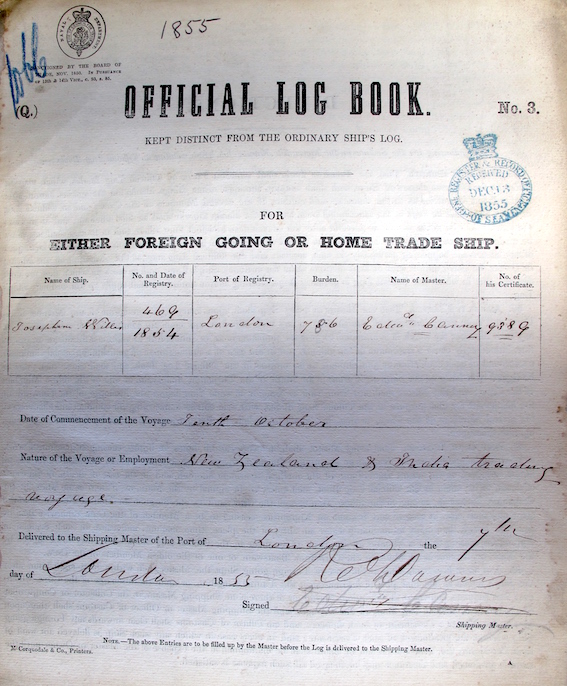
The maiden voyage of the Josephine Willis, between November 1854 and October 1855, purpose was the safe delivery of its passengers and cargo to New Plymouth and Auckland from the British Isles. The voyage followed a global circuit, direct to New Zealand, then homeward, navigating the Torres Strait and passing the Islands of Timor to reach Calcutta, where it loaded linseed and sugar for the return. Throughout the transit, Captain Edward Canney remained acutely aware of the stakes: at the New Plymouth Roadstead, he recorded the ship's value at £17,000 and the cargo at £20,000, noting that "the persons' lives on board of more consequence than all"².
While the vessel successfully fulfilled this mission, the official logbook kept a record of the constant management required to balance the safety of the ship with the challenges of crew illness and localised instances of friction between them.
Managed Insubordination and Passenger Cooperation
While the majority of the crew remained focused on the voyage's goals, a small minority engaged in defiance.
On Christmas Day 1854, the Cook, Robert Crick, became "intoxicated challenging people to fight," and William Jones fell into a "mad drunken fit," using "revolting and disgusting language" and "hammering a twelve pound cannonade with his fist"³.
This behaviour created a logistical challenge at the New Plymouth Roadstead. On January 25, 1855, five seamen—William Jones, James Mess, Edward White, John MacPhill, and William Seymour—refused to take watches⁴. This refusal coincided with a period where five other crew members were off duty due to illness. On January 29, while anchored, these five men remained in the forecastle "singing and making a riotous noise," an atmosphere the Chief Officer, Henry Gray Ray, described as being "more like a Pot House than anything else"⁵. Official Log Book - The National Archives BT 98/4231
Rather than the situation spiralling, it was managed through the cooperation of the passengers. The "1st, 2nd and 3rd Class passengers" stepped forward to assist the remaining officers and crew, working the anchors to get the vessel under weigh safely⁵. During this time, a cask of Brandy was found "Broached" and "several gallons deficient," suggesting the strike was fuelled by spirits⁵.
Professional Standards and Command Friction
The burden of ensuring the safety of these cooperating passengers fell heavily on Edward Canney, who documented several professional lapses by his senior officers. He recorded finding the Second Mate, Robert Henry Lewis, "sitting on the fore part of the sky light in a sleeping position"⁶. Though Robert Henry Lewis denied the charge, Edward Canney noted that the officer "never heard or saw me come on deck till I took hold of him"⁶. On October 21, 1855, the Captain discovered the Chief Officer, Henry Gray Ray, "stretched out on the top sky light fast asleep" at 3:00 AM, while the ship was in the track of outward-bound vessels⁷.
Significant contention arose regarding the officers' use of physical discipline. On December 2, 1854, following a complaint from the passenger Joseph Brown, the Captain found that Robert Henry Lewis had struck Midshipman Robert Jameson, leaving the boy "crying bitterly"⁸. When confronted, Robert Henry Lewis attempted to justify his actions by claiming the boy had been insolent. Edward Canney rebuked the officer, recording that he considered it a great piece of impropriety for any officer to strike a youngster⁸.
A more severe incident occurred in Auckland involving Henry Gray Ray, who administered what the Captain described as an "unmerciful beating" to James Durston⁹. Henry Gray Ray attempted to justify the violence by claiming the boy did not return immediately when he was told; however, the Captain found the severity of the correction far outweighed any such fault. While at Auckland, a shore surgeon came on board to examine the boy and reported that his back was "black and blue" for "eighteen inches," stating that "little more would have cost the boy his life"⁹. These events forced Edward Canney to strip the officers of their disciplinary powers, informing them that the youngsters were placed under his protection and ordering that any future faults must be reported directly to him⁹.
Professional friction also extended to technical competence. On September 30, 1854, after passing an American ship and exchanging signals, Henry Gray Ray told the Captain he was wrong and did not know how to signal ships¹⁰. Edward Canney found this to be an example of "unwarrantable presumption and assurance in his own abilities," noting he was thoroughly acquainted with signals before Henry Gray Ray was born and that the officer had only learned to know the flags on this voyage¹⁰.
The professional relationship with Henry Gray Ray reached a final breaking point on October 23, 1855. Henry Gray Ray claimed he had been told by another captain that he had to bully Edward Canney into doing his duty, a statement Edward Canney recorded as an "abominable falsehood"¹¹. After being accused of being "muddled with smoke and drink" in Calcutta, Henry Gray Ray flew into a "most desperate rage," struck the cuddy with his fist, and repeatedly shouted, "you are a bloody thundering liar"¹¹. Edward Canney promptly relieved him of duty, instructing him to "consider yourself as a passenger for the time being"¹¹.
The Culinary Crisis and the Ship's Cooks
The ship’s galley was a persistent source of disorder, beginning with Robert Crick. Beyond his Christmas Day intoxication, Robert Crick displayed what the Captain termed "diabolical conduct"¹². When the five mutineers were taken into custody in Auckland, Robert Crick was seen shaking their hands and shouting for the onlookers to cheer them¹³. Further logs revealed he kept the galley in a "filthy state" and failed to cook food in a proper manner, leading to his demotion to ordinary seaman¹². On February 9, 1855, Robert Crick, along with Ararat White and John Randal, lowered the captain’s gig and "absconded"¹⁴. They were later sentenced to "7 Months Goal."
The management of the galley remained unstable following the desertions. Joseph Woodham, originally the ship's butcher, agreed to take the cook's berth for the journey to Auckland¹⁵. However, his performance was marred by negligence; he was fined £3 10s after he failed to feed two pigs for 48 hours, causing them both to die¹⁶. By June 4, 1855, in Calcutta, Joseph Woodham informed the Captain the duty was too arduous and he could do it no longer¹⁷.
To replace him, Henry de Cruz was shipped as the new cook in Calcutta on June 4¹⁷. His tenure proved no more successful, as by August 15, the Steward reported that the cook was "quite incompetent" and that not a single saucepan in the galley was clean¹⁸. Edward Canney threatened to reduce the wages of Henry de Cruz for incompetency unless his standards improved immediately¹⁸.
Desertion, Defiance, and the Sick List
The stay in Auckland saw several individuals choose to leave the vessel besides the cooks. Other desertions included Edward Good, John Arnott, William Bravender, and apprentices Thomas Fossey and Theophilus Frankland¹⁹.
Verbal and physical defiance persisted among the remaining minority. On February 28, Alvan Vass refused an order and told the Second Mate to "ask his bloody ass"²⁰. In the resulting scuffle, Alvan Vass "bit [Lewis] in the left breast and struck [him] in the left eye"²⁰. Later, on May 17, James Cobin—who was noted as being "obliged to be hoisted out of the hold drunk"—was logged for telling the Third Officer to "go to !BUGGERY!" when ordered to work²¹.
The logistical pressure was worsened by a significant medical list:
Samuel Singleton (Surgeon): Died in an Auckland hospital of "Delirium Tremens" on March 21, 1855 (Duration: unfit for duty approx. 3 weeks)²².
J.R. Blaithwayte (Steerage Passenger): Died of "Typhus Fever" (Duration: approx. 1 week).
William Bravender: "Inflamed Testicles" (Duration: 11 days).
Alvan Vass: "Warts on perinaeum" and an "Abscess in groin" (Duration: 12 days).
John Shelly: "Stomach affection" and "abscesses in groin" (Duration: 15 days).
Alfred Haven: "Rheumatism in knee" (9 days) and "Typhus Fever" (14 days).
James Mess: "Ulcer on Heal" (Duration: 10 days).
Alfred King: "Debility" (Duration: approx. 20 days total).
John Grindle: "Diarrhoea" and "Constipation" (Duration: 7 days). His stomach issues frequently aligned with his sobriety; the Captain noted on March 1st that John Grindle was becoming a regular nuisance through his drunkenness²³, and on May 17th he was again "so drunk as to be unable to do anything"²¹.
James Cobin: "Bilious Fever" (Duration: 6 days). The absence of James Cobin was a recurring issue; on May 17th, he was found "so drunk he could not stand" and had to be "hoisted out of the hold"²¹. On June 1st, he was again unable to work due to having been drunk the day before²⁴.
Physical accidents also occurred; William Waters, an apprentice, was off duty for 12 days after he "fell from mizzen stay"²⁵, and William Seymour was incapacitated for 5 days with a "wound in hand" received while disarming an intoxicated John Grindle³. Despite these obstacles, the Josephine Willis successfully fulfilled its primary mission to New Zealand and completed its commercial obligations in Calcutta.
 |  |
= = = =
Footnotes (Event Chronology)
November 1854 – October 1855 (Total voyage duration)
January 24, 1855 (Valuation entry recorded at the New Plymouth Roadstead)
December 25, 1854 (Christmas Day disturbance; John Grindle disarmed by William Seymour)
January 25, 1855 (Seamen William Jones, James Mess, Edward White, John MacPhill, and William Seymour refuse watches)
January 29, 1855 (Forecastle noise, passenger assistance with anchors, and broached brandy)
July 19, 1855 (Second Mate Robert Henry Lewis found sleeping on the skylight at 4:30 AM)
October 21, 1855 (Chief Officer Henry Gray Ray found sleeping on the skylight at 3:00 AM)
December 2, 1854 (Robert Henry Lewis strikes Midshipman Robert Jameson following a passenger complaint)
February 20, 1855 (The beating of James Durston and subsequent shore surgeon examination)
September 30, 1854 (Signal exchange dispute with an American ship regarding Henry Gray Ray)
October 23, 1855 (Final confrontation in the cuddy and relief of duty for Henry Gray Ray)
February 1, 1855 (Demotion of Robert Crick to ordinary seaman for "diabolical conduct" and a filthy galley)
January 30, 1855 (Robert Crick logged for cheering mutineers in Auckland)
February 9, 1855 (Robert Crick, Ararat White, and John Randal abscond in the captain’s gig)
February 10, 1855 (Joseph Woodham accepts the cook’s berth)
May 21, 1855 (Joseph Woodham fined for the death of two pigs through neglect)
June 4, 1855 (Joseph Woodham resigns; Henry de Cruz shipped in Calcutta as the new cook)