Captain Edward Canney (1812-1856)
Edward Canney, Master of many ships of which the Josephine Willis was his undoing.
Edward Canney: a Life and Death at Sea.
Written by James Canney. This is an updated version of the original published in the Journal of the Kent Family History Society, September 2024.
Edward Canney was born on the 18 June 18121, fourth child of eight, born to Edward Canney2 and Ann3 (née Finnis), of Deal, Kent. His forefathers had been expert mariners on the Kent coast for generations, many of them had also been Cinque Ports Pilot at Deal4.
The Fellowship of the Cinque Ports Pilots was a confederation of skilled local mariners that guided sailing ships along the southeast coast of England and to France and the Low Countries. Their navigational skill prevented the loss of countless lives from shipwreck, along with much valuable cargo that might otherwise have been lost to the sea.
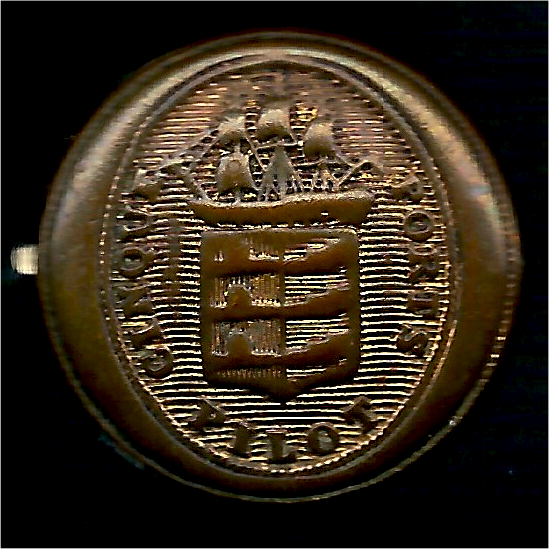
The Pilots were well paid for their services and jealously guarded their ancient legal rights to the work; they were regulated by a strict and ancient code of practice with a roster system granting each pilot turns at getting employment4. The Brethren, as they were known, also acted as a benevolent society looking after the retired pilots and their families should they die in service.
Prospective pilots would already be experienced sailors but needed to pass an examination and be proven capable at sea before having their names entered into the ‘Lower Book’ of the pilots. Promotion to the senior ‘Upper Book’ was contingent upon time served and the passing of a further examination; promotion allowed a pilot to command larger vessels and earn greater pay. His uncle John Canney5 and several of his cousins, were also still serving pilots at Deal during Edward’s lifetime. His grandfather Richard Ladd Canney6 and great-grandfather Richard Canney7 served as pilots, they had additionally been elected as Wardens of the pilots at Deal; as such they would arbitrate when the interests of any two pilots did not align, a well-respected senior position in the town. Several other cousins and relatives by marriage if not pilots were often working, along with most of the population of Deal, earning their living directly or indirectly from the sea. It would have been expected as a young man such as Edward to follow in the family tradition and become a mariner.
Edward’s father had taken his professional seafaring in a slightly different direction and was a Hoyman. He had shares in the ownership of at least two Hoys, the Union and the Phoenix8. These single masted, sloop rigged ships, specialised in carrying passengers and freight up and down the coast. His ships plied mainly to London with a regular berth at St Botolph’s Wharf, near the tower of London. It would have been no surprise, indeed probably expected, for a young man such as Edward junior to follow in the family tradition and become a mariner.
The 1790s had been kind to the inhabitants of the borough and town of Deal. Adjacent to the shore and in the lee of the treacherous Goodwin Sands, which acts as a natural breakwater, an area of water known as The Downs gave shelter to sailing ships against adverse weather or tides before they headed into the English Channel. This stopping off point afforded the local townspeople of Deal much business, supplying ships with provisions and pilotage. The war with France meant that British naval ships could often be found in The Downs providing a boon to Deal and so it was that the town’s population grew in proportion to the needs of the shipping9. Predictably smuggling had always been an additional source of income for mariners at Deal; many took advantage of their freedom to travel back and forth to the continent and to commune with the many ships lying at anchor so close by. These ships, mainly legitimately collecting provisions and delivering mail, might have crew willing to sell illicit goods ‘over the side, Edward Canney’s cousin Richard Canney10 was implicated in one such import11.
“CHARGE OF SMUGGLING - William Kay, Richard Philpott, George Whittingstall, Robert Spice, John Philpot, Richard Canney and Davidson, seamen on board HMP Princess Alice, charged with concealing on board the vessel, 99lbs of foreign tobacco in 1lb or 1⁄2lb packages. David Avford [sic] was blamed as he had absconded and supposed the guilty party. Ship's commander was Lieut Scrivens, quarter-master was Thomas Kay. Tobacco was hidden between skirting and bulkheads in the forecastle”.12
With the defeat of Napoleon the fortunes of Deal declined; the decreased naval presence in The Downs and the introduction of steam-powered ships lessened the need for many to sojourn in The Downs, leading to a reduced requirement for the associated shore services. Young Edward seems to have seen the writing on the wall and opted to become a sailor in the Merchant Navy, starting as “boy” in the long-distance foreign trade where the tall sailing ships still ruled the waves.
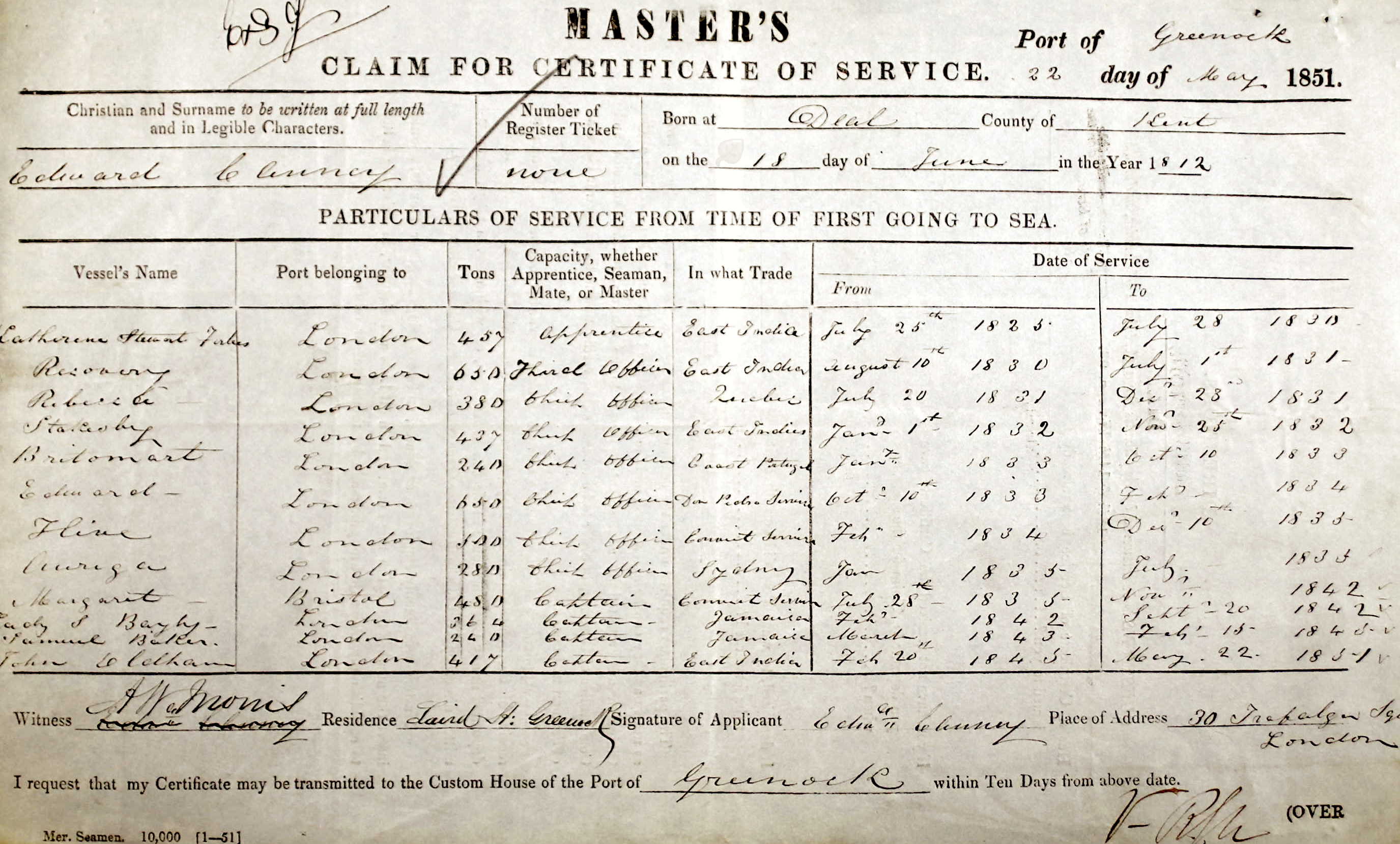
Edward’s first job at sea was as a ship’s boy in 18251, aged 12 years old, aboard the Katherine Stewart Forbes13 captained by Ingram Chapman (probably related to the vessel owners, Chapman & Co.). The ship was chartered by the East India Company but on one of Edward’s first voyages she sailed to Australia; conveying the newly appointed Governor General, Sir Ralph Darling and troops of the 40th Regiment to SydneyTown14. This first position was probably as an apprentice and may have been secured via his older first-cousin, Thomas Canney15 who was already in the East India Service. In 1829 Edward served under his cousin when Thomas became captain of the Katherine Stewart Forbes16.
Edward later transferred to another Chapman & Co. ship the Recovery17, gaining a promotion1 to 3rd Mate under Captain Henry Cleaver Chapman (presumably related to Captain Ingram Chapman and the ship-owners). He sailed with the Recovery for about a year before being promoted again, now to 1st Mate and joining the Rebecca18 (312 tons) sailing to Quebec. His last trip on a Chapman & Co. vessel was in 1832 on the Stakesby19, plying the East India Trade. He then serves for a year as Chief Officer (1st Mate) for the Britomart20 in the Lisbon service off Portugal sailing with his younger brother James Claringbold Canney21 who was serving as ordinary seaman on the same ship. Edward then goes on to do about six months aboard the ship Edward22 in the Don Pedro Service.
In February 1834 Edward put to sea as 1st Mate with the Hive, under Captain John Henry Luscombe, taking 250 male convicts to the Sydney23 penal colony; a lengthy 123 day non-stop passage, whereby in extreme24 heat two convicts died under Captain John Thomas Nutting taking 252 male prisoners, 29 soldiers of the 18th regiment, eight women and eleven Children from Cork to Sydney.
He sailed again on the Hive in late August 183525. At midday on 10th December the Hive was about 12 miles off Montague Island on the New South Wales Coast; by eight o’clock, Edward, as Chief Officer advised Captain Nutting that the ship was 8-9 mile off land and the current heading needed adjusting before nightfall but Nutting insisted that land was still 12 to 14 miles away, saying “one person is sufficient to navigate the ship”. Even having been snubbed by the Captain and at the end of his watch Edward did not turn-in for the night but stayed on deck and cautioned the officer of the watch, Thomas Morgan (3rd Mate), to take in some sail but Morgan refused, afraid to countermand Nutting’s instruction to carry full sail. Edward retired below deck only to be roused by Morgan saying that he could see breakers off the port bow. Rushing on deck Edward issued orders for sails to be thrown back. Captain Nutting staggered up on deck (four sheets to the wind himself maybe?), counter ordered that the yards be braced and studding sails taken in, appearing incapable of commanding the now grounded ship. Edward asked for more orders but Nutting said, “he should do what he thought best”, so he called for the ship’s long boat to be lowered as it might withstand the rough surf; Nutting contradicted and insisted the smaller jolly boat be put out. Edward followed his instructions but insisted he be one of three men to attempt to put a line ashore. No sooner had the jolly boat been put in the water than violent sea swamped it, Edward managed to grab a rope from the ship and also haul Ensign Kelly of the Engineers back onto the deck, saving both of their lives; the third of their company made it to shore on the capsized boat. One of the ship’s boys had tried to swim for the beach but was tiring fast; John Edwards, the Boatswain jumped overboard to save the lad but struck upon the ship’s stern and was26 drowned . At this point the Ship’s Surgeon, Anthony Donoghoe and the commander of the guard, Lt Edward Lugard, concluded Captain Nutting to have “lost all presence of mind” and demanded he stop issuing any further orders. They offered command to Edward, as Chief Officer, but he refused to depose Nutting, ‘not knowing by whose authority they could do so’. Nonetheless, exhausted as he must have been, he volunteered to swim ashore with a line. Nutting finally consented to the long boat being cleared and Edward set to ferrying all 300 or so survivors ashore. Having survived the ill fated Hive, Edward worked his passage27 home as 1 Mate on the Auriga, taking with the him one of the ship’s apprentices, William Green and a ship’s boy, Stephen Norris from the crew of the Hive; both travelled with Edward on his next two voyages with promotions as 2nd Mate and Apprentice respectively28.
At the age of just 24, Edward becomes a Master Mariner and takes command of his first ship, the Margaret, on November 16 183629.
He undertakes three voyages as captain of the Margaret30, transporting woman convicts and free settlers to New South Wales. Each round-trip taking almost two years, trading along his route home to make as much money from each voyage as possible for the ship owners. As the captain he would have had a share in any profits made so it was in his own interest to do well in this his first trip as the Master of his own vessel.
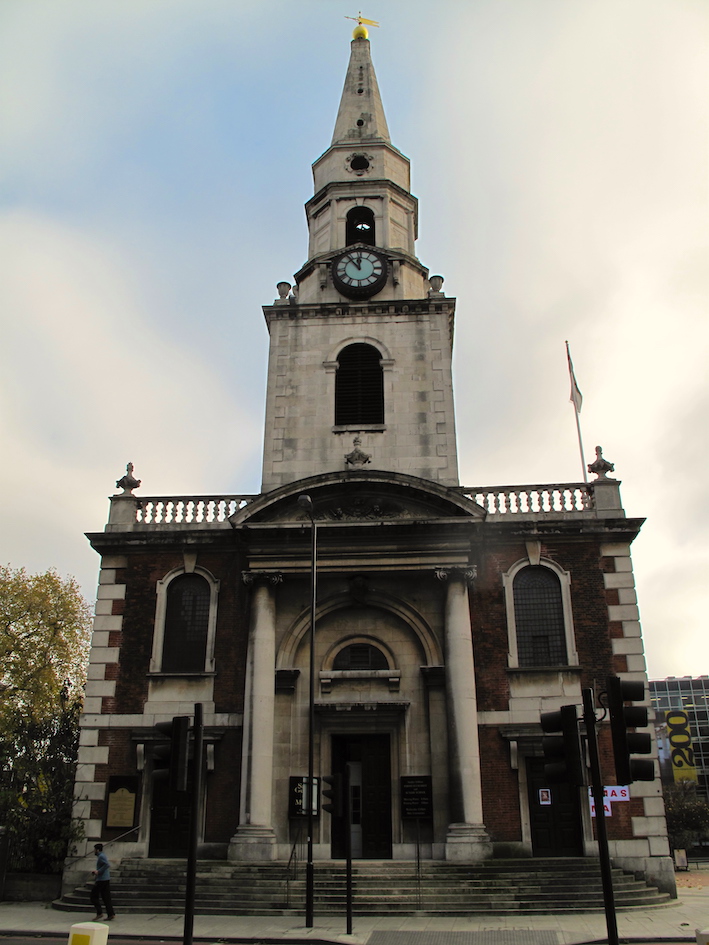
Upon his return to London he marries Mary Ann Birch31 (who is ten years his junior),at St George the Martyr’s Church in Southwark32, daughter of Edward Birch and Mary Ann (née Curling) of St Peter’s, Ramsgate. After a short break or maybe a honeymoon, Edward takes to the sea again for a round trip voyage to Jamaica aboard the Lady Sarah Bayly33. His younger brother James Claringbold Canney had previously been captain of this ship in 183934. Edward only takes the captaincy from June until September 18421, arriving back to England in plenty of time for the birth of his first child, Edward, born at St Peter’s, Ramsgate on 10th December 184235 (hereinafter referred to as Edward junior). Edward’s older brother, Richard Brice Canney36, also a master mariner, immediately succeeded command of the Lady Sarah Bayly for several more voyages back and forth to Jamaica37; probably his brother’s position was gained at the recommendation of Edward, he having possibly chosen to stay with his wife for her confinement, or maybe just perpetuating his family’s line in nepotism by finding other family members work at sea. It certainly cannot be a coincidence that all three Canney brothers were captains of the same ship at various times.
Edward appears to have done a good job for the ship owners because he spends the next three years commanding another ship, Samuel Baker38, belonging to a Samuel Baker of Gloucester who was also one of the co-owners of the Lady Sarah Bayly. Edward seems ultimately to have given up this place as captain of the Samuel Baker in a possible attempt to be at home for the birth of his second child. His final listed voyage on the Samuel Baker39 arrived at London on 21 November 1844. However his plan seems to have gone awry or maybe the baby was later than expected because he was already signed up as master on another vessel, the John Oldham40, which sailed for Jamaica on the 14th January 1845. His son Richard was born in the absence of his father on the 27th January 1845 at No. 7 Albion Road, Dalston in London41. Maybe by way of apology Edward employed his wife’s younger brother, Edward Birch42 as a ship’s apprentice, possibly this earned some forgiveness at home but as we shall see later, Mary wasn’t to be caught out having babies at home alone again. He remained master of the John Oldham (a Fletcher & Co. owned ship) for six years. Between sailings he and Mary moved home from Dalston to a family-sized house on43 Trafalgar Square in Old Town, Mile End and they have a daughter, Mary Ann44 (hereinafter referred to as Mary Ann junior). Edward was this time in the country for the birth (he registered the birth too).
Commanding another Fletcher & Co. ship on 1st August 1851, the Lord William Bentinck45 (443 tons), his largest ship so far; a square rigged barque with three masts, standing bowsprit, 111 feet long and 39 feet in breadth, she was built at Southtown in Suffolk by Frederick Preston in 1828 with the bust of a man as a figurehead46 (presumably it looked like the eponymous Lord Bentinck of Portland). The owner, Joseph Fletcher of Shadwell Dock, Limehouse, had previously owned the John Oldham and his patronage of Edward’s services as a captain continued on this second ship with good cause it seems. Edward and his crew were highly praised in a letter to the Australian newspapers47 in relation to this voyage:
‘An extraordinary case of good conduct among seamen having recently come under my observation... to prove that seamen when properly treated are capable of appreciating kindness and good management. The ship Lord William Bentinck went to three ports in New Zealand and Sydney, from thence to Madras, Singapore and China, across to Manila and took a cargo of sugar again for Sydney and finally loaded home from thence to London. The said crew continuing throughout this long period, faithfully, soberly and carefully performing their duty... Upon consideration of such services, the owners handsomely remunerated the crew upon their return on the 2nd October 1853, having been absent for upwards of two years. Every possible inducement was held out for them to desert, but to no purpose; they considered they had a good home in their ship, were kindly treated by their captain, and every individual became attached to the ship’.
It should be noted that, not mentioned in the news article, whilst away on the same two year journey, the ship also undertook a side-trip from Sydney to Valparaiso in Chile and back to Sydney, bringing horses to the colony. It was not a particularly successful part of the overall venture because sadly many of the horses being transported died due to rough seas in foul weather.
The crew list for this two year odyssey shows only three men deserted48; two at Sydney and one at Wellington, quite likely they either never intended to make the return trip or did not want to spend another half a year getting home. This letter gives the impression that Edward was a fair taskmaster on-board ship but does not make anything of the fact that he had taken his wife and two year old daughter on the journey. Mary’s presence as a passenger for the voyage may or may not have made a difference to the crew’s behaviour, or her husband’s for that matter but it seems she might have known something he didn’t before they departed London; Eight and a half months into the voyage on the 17th of April 1853, she gave birth to a son on-board the Lord William Bentinck, whilst docked in Circular Quay, Sydney, their fourth child49. More or less in accord with the tradition of the sea the baby was named after the ship and was called, Bentinck. Presumably this voyage had been very profitable for upon reaching home, Edward does not appear to undertake another foreign engagement for ten months.
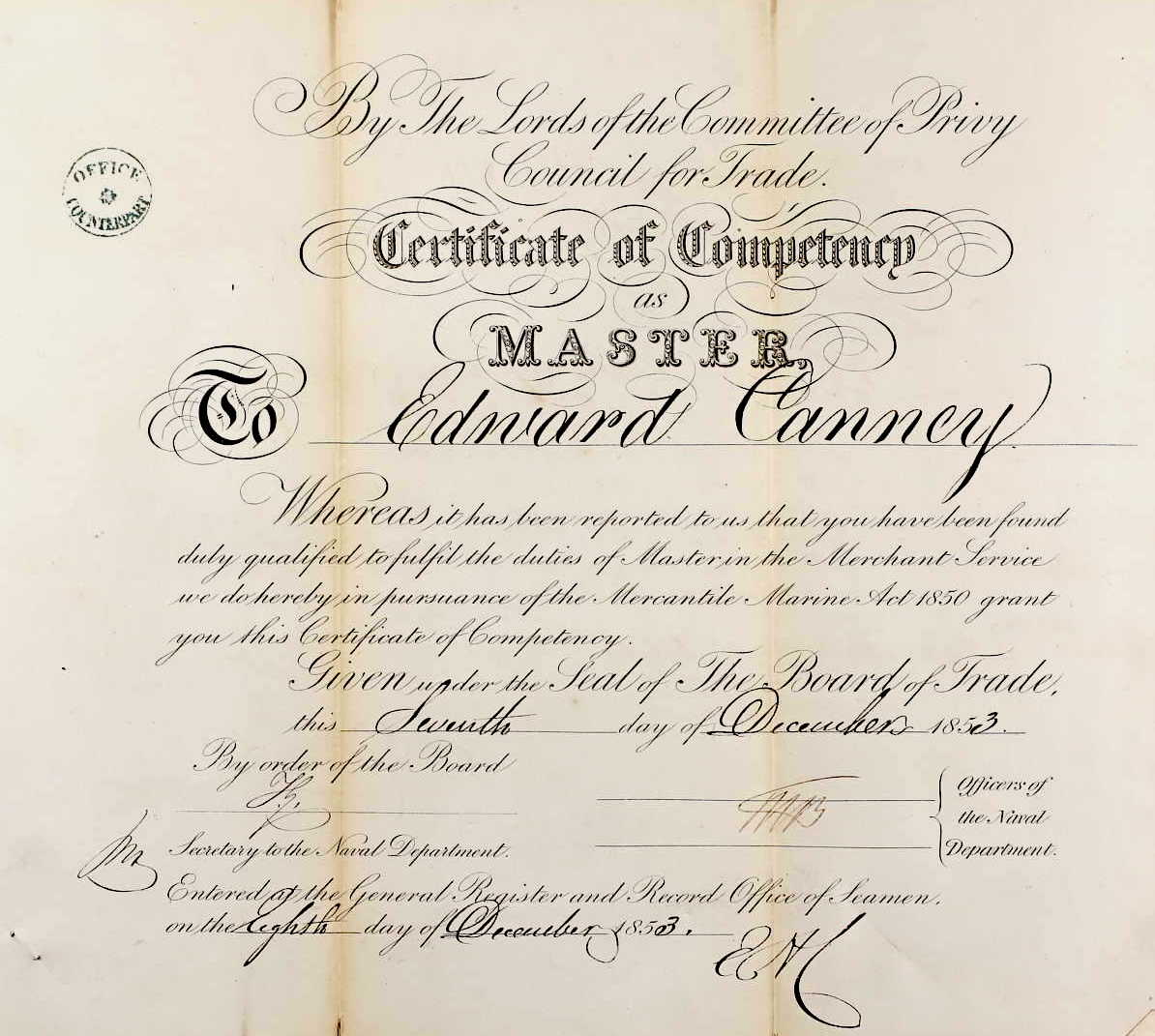
When he goes back to sea Edward takes charge of a newly built ship the Josephine Willis (786 tons) owned by Fletcher & Co., at 153 feet long she is considerably larger again than his previous ships. Chartered by Gann & Co. to take provisions and settlers to New Zealand and trade on the home run the voyage does not go smoothly. In contrast to his previous successful sailings the ship’s log details not just the ship’s coordinates and the food stores etc. but inventories the poor behaviour of the crew 50 and some of the colourful language they used50.
His Chief Officer for the maiden voyage, Henry Gray Ray, had previously been 2nd Mate on the Lord William Bentinck but on this trip he seems to have been at loggerheads with Edward from early in the voyage. Ray was brother-in-law to the ship’s owners, the Fletcher brothers which must have been a complicating aspect when Ray repeatedly acted up onboard. Even before the ship is out of the English Channel Ray tried to get the Captain’s steward to sell him Brandy. Ray is reprimanded on several occasions; being asleep on watch and setting a bad example to the crew by drinking and smoking on deck. Two thirds of the way through the voyage Edward records a quarrel when he tells Ray to temporarily consider himself a passenger.
Robert Crick, the Cook, is frequently drunk and aggressive and keeps the galley in an unfit state; after being demoted, he eventually he absconds from the ship at Auckland.
At New Plymouth, five ordinary seamen, William Jones, James Mess, William Seymour, Edward White and John MacPhee, effectively mutiny by refusing to work for ten days. The passengers and officers have to help weigh anchor because five other ship’s hands are sick that day. Refusing duty on a merchant ship was not subject to the harsh penalties of the Navy, such as flogging, but breaking their employment contract meant at least docking of pay and if endangering the ship, sailors were subject to action at law; the local magistrate in Auckland gave the mutineers and the cook seven months in gaol.
Able seaman James Cobin, was ‘obliged to be hoisted out of the hold drunk’, calling the chief officer ‘a bugger’ and telling the 2nd Officer and the Captain to ‘ex [expletive] his ass – making a disreputable noise and destroying the peace of the ship. Strongly suspected of embezzling ships cargo.’ A crate was later found to be deficient of five bottles of gin!
The captain’s woes were compounded further when Chief Officer Ray, badly beats able seaman James Durston, for not bringing back some other crew members that had over stayed their shore leave. Durston states ‘the chief mate through [sic] him off the Rail calling him a Bugger that the doctor was drunk and the chief mate very much excited.’ The boy survives and gets bed rest for a week but the ministering ship’s surgeon, Samuel Singleton, later dies at Auckland of ‘delirious tremens’, normally associated with consuming too much alcohol.
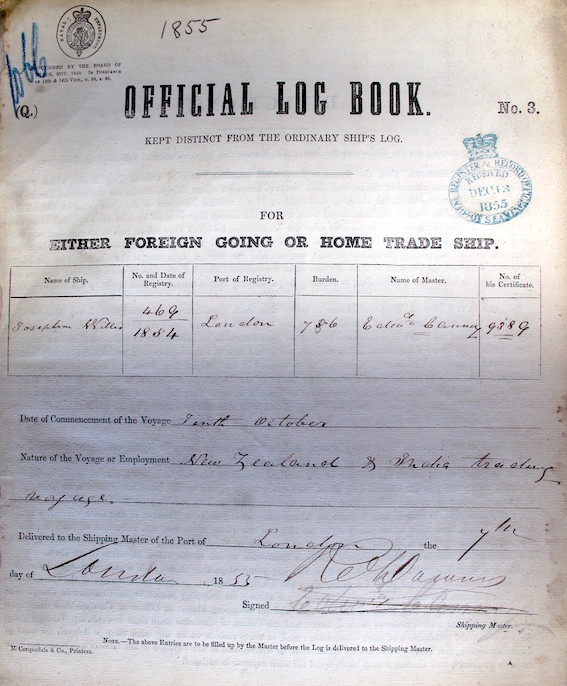
At length Edward records his crew’s drunken journey to and from New Zealand albeit also documenting his personal concern for the young Durstun and his frustration with his chief officer and 2nd Mate. In all, twelve crewmen deserted (including the mutineers) at Auckland and four more were discharged at Calcutta. Upon the ship’s return to London on 6th December 1855, Edward appears to have reconciled with Henry Ray because he reports on the crew agreement that both his ability and conduct are ‘good’; however with regard to the 2nd Mate, Robert Henry Lewis, he ‘declines to report’, one assumes inferring he would not say anything, good or otherwise. Or was it just that he could not say otherwise due to Ray’s family connections?
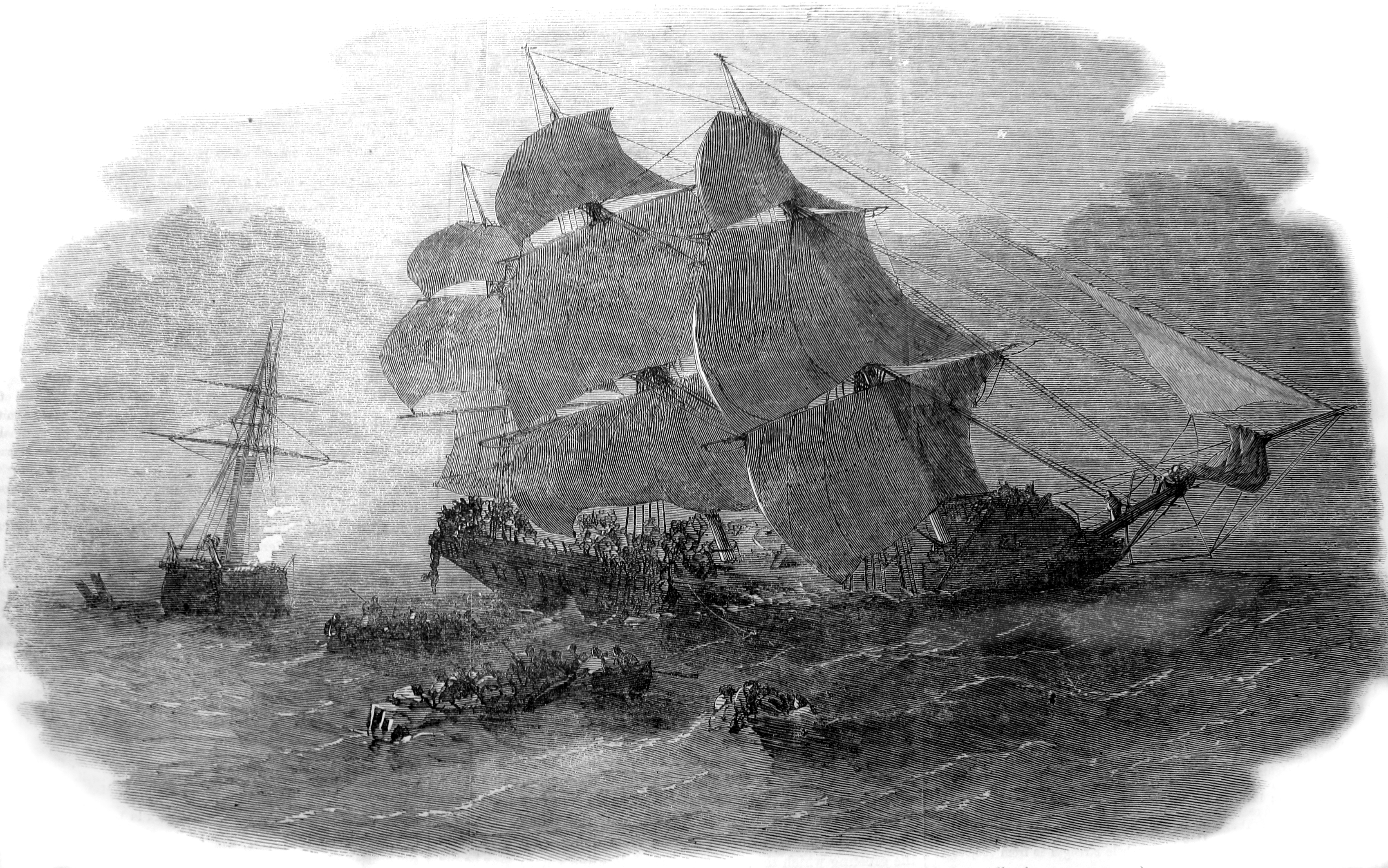
The Josephine Willis sailed again for Auckland under Edward Canney with 66 passengers and 44 crew51; the crew consisting only of the sailors deemed ‘good’ or ‘very good’ from the previous troubled voyage52 (Henry Gray Ray was not included as crew but was, possibly awkwardly for the Captain, aboard as a passenger with his wife), the rest were all new hands to the ship, including John Hodgkinson53, step-son of Edward’s sister Anne54. The ship departed Saint Katherine’s Dock in London on Saturday 2nd February 1856, towed by steam tug to Margate Sands where the tug left her under her own sail to pass through The Downs, putting off their pilot at Deal55; Edward’s childhood home. Five miles south-east of Folkestone, steering W.S.W. with a S.E. to S.E.E. wind at a speed of about seven knots the chief officer, Kester Clayton being in charge, saw a light on the starboard bow which he mistook for the Dungeness light, he starboarded the helm to take the ship further out from land. When upon realising the light to in fact be that of a steamship he continued his course, thinking the streamer would pass behind. The steamer was the screw steam-ship Mangerton (363 tons). Her helmsman ported her wheel as maritime law dictates56 but in the event she struck the Josephine Willis just in front of her main rigging, on the starboard side.
The Mangerton reversed her engines and backed off the now flooding hull of the Josephine Willis, which immediately began healing over. Captain Canney had been below plotting his charts and ran up on deck at the instant of the cries of collision. Upon seeing what was occurring he gave orders to man the pumps and for the topsails, topgallants and flying jib to be set and was about to raise the main sail, to maybe drive the ship ashore, but realising the ship was lost, he ordered the all the hencoops and anything on the decks be thrown overboard and for the life boats to be launched. Captain Richard Bouchier of the Mangerton decided not to stay long by the stricken ship as he believed his vessel too was taking on water; those of the crew of the Josephine Willis that had been got away in the life boats were too fearful of being drawn down with the sinking ship to return and get more people off. ‘There was much want of humanity... in not sending help’ 57 it being dark and so far from shore.
Edward Canney was last seen, in what would have been freezing cold water, clinging to a hencoop with two women. ‘Throughout the trying scene he is reported to have behaved with the greatest coolness and bravery’.
57 passengers and 12 crewmen were listed in the newspapers as perished in the tragedy of the Josephine Willis.
Edward’s possessions were later retrieved by salvage divers to the wreck and restored to his widow58 but it is not recorded if his body was ever found. No burial or funeral record has been located for him but his father, Edward’s tombstone in St George’s churchyard at Deal was updated to read: ‘Sacred to the memory of... Capt. Edward Canney son of the above who was drowned off Folkestone in the Josephine Willis 3rd of February 1856 aged 43 years’59.
Edward did not leave a will but administration was granted to his wife, valuing his estate at three thousand pounds60. Public testimonials to raise money for the benefit of Mary and his children were opened in Auckland and the City of London ‘that his bereaved widow may find her privations in some respect alleviated’61. She raised her family alone albeit not suffering any great financial distress, living by her own means and aided by a fortuitous inheritance from an aunt, the interest on £5,00062. Mary eventually settled to residing with her youngest son Bentinck, a City of London wine merchant, living with him in Lewisham until she died there in 1875 aged 62, leaving him the lion share of her estate63.
His Children.
Edward junior joined the Anglican Clergy becoming the vicar of St Peter’s Church, Saffron Hill; for thirty-nine years he worked tirelessly for the poor of his parish64. He had eleven children, seven whom lived to adulthood but he only had one grandchild, and they were adopted.
After a brief and scantly documented career at sea Richard, the second son, seems to have had a motley life. He travels to New York65 and back, then works variously as a railwayman and a wharf foreman, ending up as a confectioner in Mile End, near where he was born. He married and had four children, none of them mariners.
Mary Ann died in Leicester from consumption aged only 2644; she is buried with her mother in the graveyard of Saint Laurence’s Church in Ramsgate, Kent.
Bentinck, a wine and sprits merchant, married and had two children. He returned to Deal for holidays but did not take up the sea as an occupation. He died aged only 53.
Considering all his worldly travels, it seems so very a poignant ending for Edward, to loose his life so ignominiously close to where he was born. From the surviving documents, I get the sense that he was a kind man and well liked by most that knew him in life.
Bibliography
Bateson, C. (1959). The Convict Ships 1787-1868 (2004 ed.). Glasgow: Brown, Son & Ferguson.
Farrington, A. (1999). A Biographical Index of East India Company Maritime Service Officers, 1600–1834. London: The British Library.
Holyoake, G. (2001). Deal - Sad Smuggling Town. Seaford: S. B Publications.
Laker, J. (1917). History of Deal (1921 ed.). Deal: T. F. Pain & Sons.
Nutley, D., & Smith, T. (1995). 2nd Report on the Maritime Archaeological Investigation of the Convict Transport HIVE (1820-1836) Mainland Australia’s Only Convict Shipwreck. N S W Department of Urban Affairs and Planning .
Pritchard, S. (1864). The History of Deal, and it's neighbourhood, from the invasion of Britain, on the shore of Deal, by Julius Caeser, B.C. 55, to the present day (1914 ed.). Deal: Edward Hayward.
Quinton, M. (2008). The Story of St George's Church, Deal. BUSI-PRINT (Kent). Stebbing, W. (1937). The Invader's Shore. Deal: E. F. Howe.
End Notes:
1 Master’s claim for certificate of service, National Maritime Museum: Cert No.s 70,611 & 9,389
2 1782-1836: Society of Genealogists [SOG]- KE/R95-98 & Grave at St George’s, Deal, Kent
3 1786-1875: SOG - KE/R95-98 & Civil Death Reg: Sep 1875 Brighton 2b 132
4 East Kent Archive ref: Cpw/LE1
5 1774-1838: SOG - KE/95-98 & Civil Death Reg: Sep 1838 Eastry 5 73
6 1751-1828: SOG - KE/95-98 & KE/R208
7 1726-1789 (aka Richard KENNY5): SOG KE/95-98 & Gravestone at St George’s, Deal
8 Deal Maritime Museum, Ref: WH-C 6-7
9 (Pritchard, 1864) page 321
10 1788-1875: SOG - KE/95-98 & Death Cert: Mar 1875 Eastry 2a 625
11 (Holyoake, 2001) page 132
12 Dover Telegraph: Petty Sessions - 19th June 1847 Page 8 Column 3
13 National Archives: British Register of Shipping (BT)- BT107/38 279/1824 (457 tons reg)
14 Hobart Town Gazette: 26th Nov 1825 Page 2 Column 2
15 1797-1863 (son of R.L.Canney7): SOG - KE/95-98 & Civil Death Reg June 1863 Gravesend 2a 205 Commander for East India Company
16 (Bateson, 1959) Page 348/349
17 (Farrington, 1999) Page 131. National Archives: BT107/41 47/1825 (493 tons)
18 National Archives: BT107/43 381/1825 (312 tons)
19 National Archives: BT107/74 119/1838 (437 tons)
20 National Archives: BT107/72 342/1837 (242 tons)
21 1816-1889: SOG - KE/95-98 & Civil Death Reg: Dec 1889 Brighton 2b 164
22 National Archives: BT107/52 117/1828 (406 tons)
23 (Bateson, 1959) Page 389
24 (Nutley & Smith, 1995) Pages 8 - 10
25 Kenny name is misused in some contemporary sources quoted by Bateson and Nutley/Smith.
26 Letter to the Editor of the “Herald” (Sydney), 12th January 1836. Mitchel Library, NSW
27 National Archives: BT107/55 228/1829 (231 tons)
28 National Archives: Crew List BT98/188
29 Personal correspondence from J.Kirkwood, descendent of E.Canney
30 National Archives: British Register of Shipping BT107/64 191/1834 (364 tons) 32 (Bateson, 1959) Page 354 & 356
31 1810-1859: SOG - KE/R95-98 & National Probate Register 1859
32 Marriage Certificate: Mar 1842 Southwark St Geo 4 343
33 National Archives: British Register of Shipping BT107/79 391/1839 (365 tons)
34 Master’s claim for certificate of service, National Maritime Museum: Cert No. 37,397
35 Birth Cert: Dec 1842 Isle of Thanet v 465
36 1810-1859: SOG - KE/R95-98 & National Probate Register 1859
37 National Archives: Crew List BT98/371
38 National Archives: British Register of Shipping BT107/84 127/1841 (209 tons)
39 National Archives: Crew List BT98/379
40 National Archives: British Register of Shipping BT107/75 378/1838 (417 tons)
41 1845-1885: Birth Cert: Mar 1845 Hackney iii 177 Civil Death Reg: Dec 1885 Bethnal Green 1c 137
42 National Archives: Crew List BT98/710, Born: 11th August 1827 Mersham, Kent
43 Renamed as “Trafalgar Gardens”, off White Horse Lane, Mile End
44 1849-1875: Birth Cert: Dec 1849 Stepney ii 479 Civil Death Reg: Dec 1875 Leicester 7a 133
45 National Archives: British Register of Shipping BT107/71 113/1837 (443 tons)
46 Many Internet references show another vessel of the same name also built in 1828 but at 564 tons. This other vessel was 123 feet long and built at Bristol by Hillhouse & Sons.
47 Sydney Morning Herald, quotes the Shipping & Mercantile Gazzett: 21st January 1854, page 4
48 National Archives: Crew List BT98/3459
49 The Sydney Morning Herald: 18th April 1853, page 3
50 National Archives: Official Log of the Josephine Willis BT/98 4231
51 The Times: 15th February 1856. Page 10 Column 5 52 National Archives: Crew List BT98/4231
52 National Archives: Crew List BT98/4231
53 1840-1920: www.ancestry.com
54 1813-1875: SOG – KE/95-98 & Civil Death Reg: Mar Steyning 2b 222
55 The Times, London: 6th February 1856
56 High Court of Admiralty: Reports 1856 Pages 120 - 124
57 The Illustrated London News: 16th February 1856
58 The Engineer Vol.1 28th March 1856 Page 168
59 Interments ceased at St George’s in 1856 other than for those in family plots (Quinton, 2008)
60 National Archives: PROB6/232/330
61 Empire: Sydney, NSW 15th September 1856, page 4
62 National Archives: PROB/11/2239 - Will of Sarah Kelly of Rookwood, Galway.
63 Family archive: Original office copy of will with a codicil. Probate value £6,697 11s 2d
64 London Metropolitan Archives: Book 5 Names of preachers and record of services P82/PET/12
65 Family archive: Indentures relating to dispersal of Edward Canney’s estate & Census 1871/81