Passenger Accommodation
Emigration was undertaken for all sorts of reasons but once the decision to travel was made there were established companies ready to facilitate the journey. Arthur Willis had been amongst the foremost specialising in conveying people to New Zealand for about ten years, he was a ship broker, charterer, owner and insurance purveyor.
Working with his sons, and his business partner Amos Gann, he created a one stop shop for all an emigrants’ needs. He was listed as the author of “The New Zealand Handbook or Emigrants Bradshaw”, the seminal guide of the day for potential emigrants. Upon the back page of this somewhat self-serving booklet was an advertisement for their own line of ships, boasting of carrying over “three fourths of the private and a large portion of the public, Emigration to New Zealand”. The whole booklet is nonetheless full of practical advice, such as; where best to settle depending upon your occupation, what farm equipment to bring with you, etc., even down to the minutia of how many sets of underwear might be needed.
Launched in July 1854, the Josephine Willis was built by the firm, Henry Fletcher, Son and Fearnall at Union Dock in Poplar, London. She was built specifically for the emigrant trade to New Zealand in a partnership with Willis, Gann and Co. Constructed as a larger sister ship along the same lines of their earlier joint venture, the Joseph Fletcher (launched March 20th 1852), the Josephine Willis was according to their respective Lloyd’s Register Surveys some 20ft longer. She was probably named for the wife of Henry Hinckley Willis, Sarah Josephine, who apparently (1851 census) went by her middle name, hence the “Josephine Willis”.
No first hand records of passenger experiences from the maiden voyage of the Josephine Willis have, as yet, been discovered. There is anecdotal mention in newspapers of it being a longer than necessary journey and these also include reporting of the “mutiny” undertaken by part of the crew.
“The fine new ship Josephine Willis, Captain Canney, arrived in harbour on Monday evening from London, via New Plymouth, after a tedious passage of 114 days. She sailed from London on the 14th passed through the Downs on the I6th, called at and sailed from Plymouth on the 23rd of October; and from New Plymouth on the 24th ult. During early part of her passage the Josephine Willis experienced light and baffling winds; but, as usual met with strong and favourable weather when the meridian of the Cape of Good Hope had been reached. We regret to say that a spirit of the greatest insubordination manifested itself, at a very early period of the passage, amongst several of the ships company. On arriving at New Plymouth, five of the number peremptorily refused to do duty any longer. In consequence of this outrageous conduct, the passengers were under the necessity of assisting in lifting the anchor and working the ship round from New Plymouth, - a spell of twelve days. It is as unfortunate as it is remarkable that Captain Canney should have had such a set to deal with. During his last command, - the Lord William Bentinck, - he was for upwards of two years off and on the gold coasts of Australia, and whilst other ships were loosing all hands, not a single man deserted from the Lord William Bentinck, which carried her crew back to London with her. where Captain, Officers, and ship’s company parted with each other on the best of possible terms. The mutineers have been handed over to the Civil Authorities, The Josephine Willis is a fine sightly ship, upon enlarged lines of the Joseph Fletcher. Her cabin accommodations are of a very superior character, and altogether, she may be regarded as a higher class vessel of her line. She brings a considerable addition to our population, and amongst them another portion of immigrants whose passages have been assisted by the pre-payment of their friends. Two births, and one death occurred during the passage.” (New Zealander 07 Feb 1855)
The only other mention found to date of anything out of the ordinary happening on the voyage was reported by The Taranaki Herald on 24th January 1855.
“Captain Canney informs us that at about half past 9 on Tuesday night last, being upwards of 150 miles from land, he experienced a shock of an earthquake — no doubt the same felt here”
This was a massive 8.2 magnitude earthquake occurring on the 23rd of January 1855, although the epicentre was near Wellington the effects were felt through much of the Cooks Straits, the Josephine Willis would have been heading towards New Plymouth at the time.
Accommodation on-board the Josephine Willis
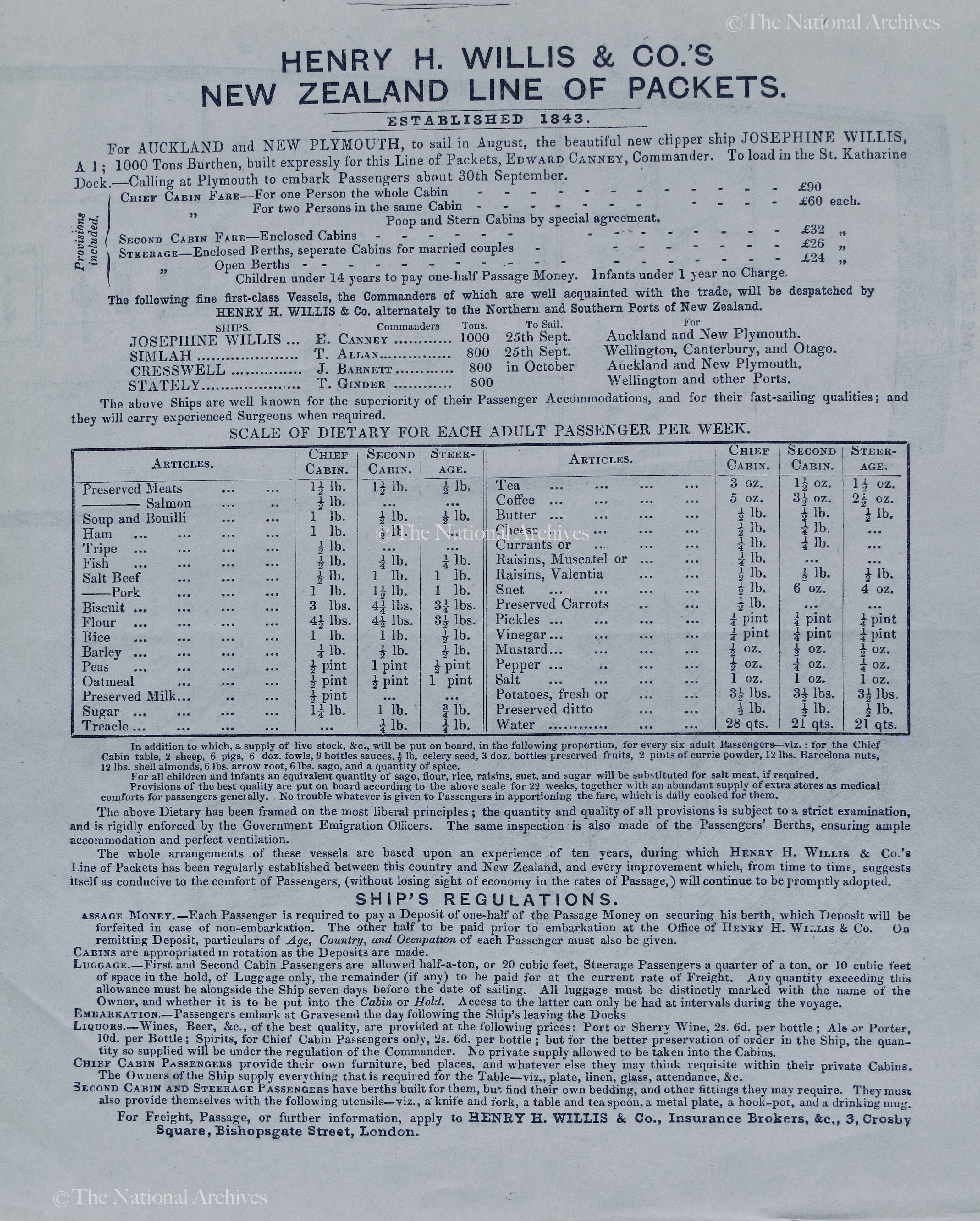
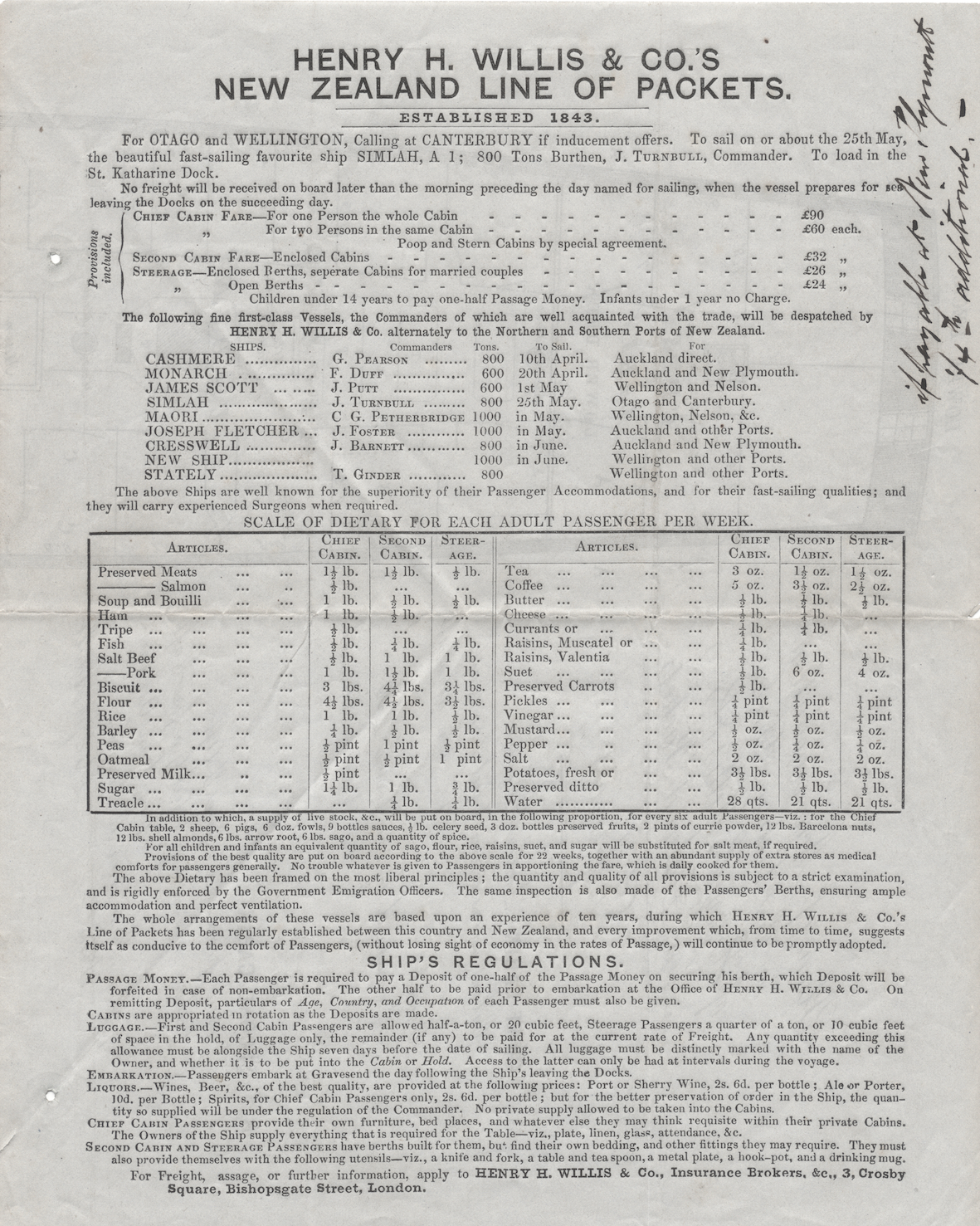
Leaflets produced by Henry H. Willis & Co. advertised the types and prices of accommodation available on their "New Zealand Packet" ships. As detailed further below, options ranged from £90 for a Chief Cabin (for a sole occupant in a larger poop or stern cabin) to £24 for an open berth. These open berths would have been three tiered bunk-style beds located in the bow of the between-decks.
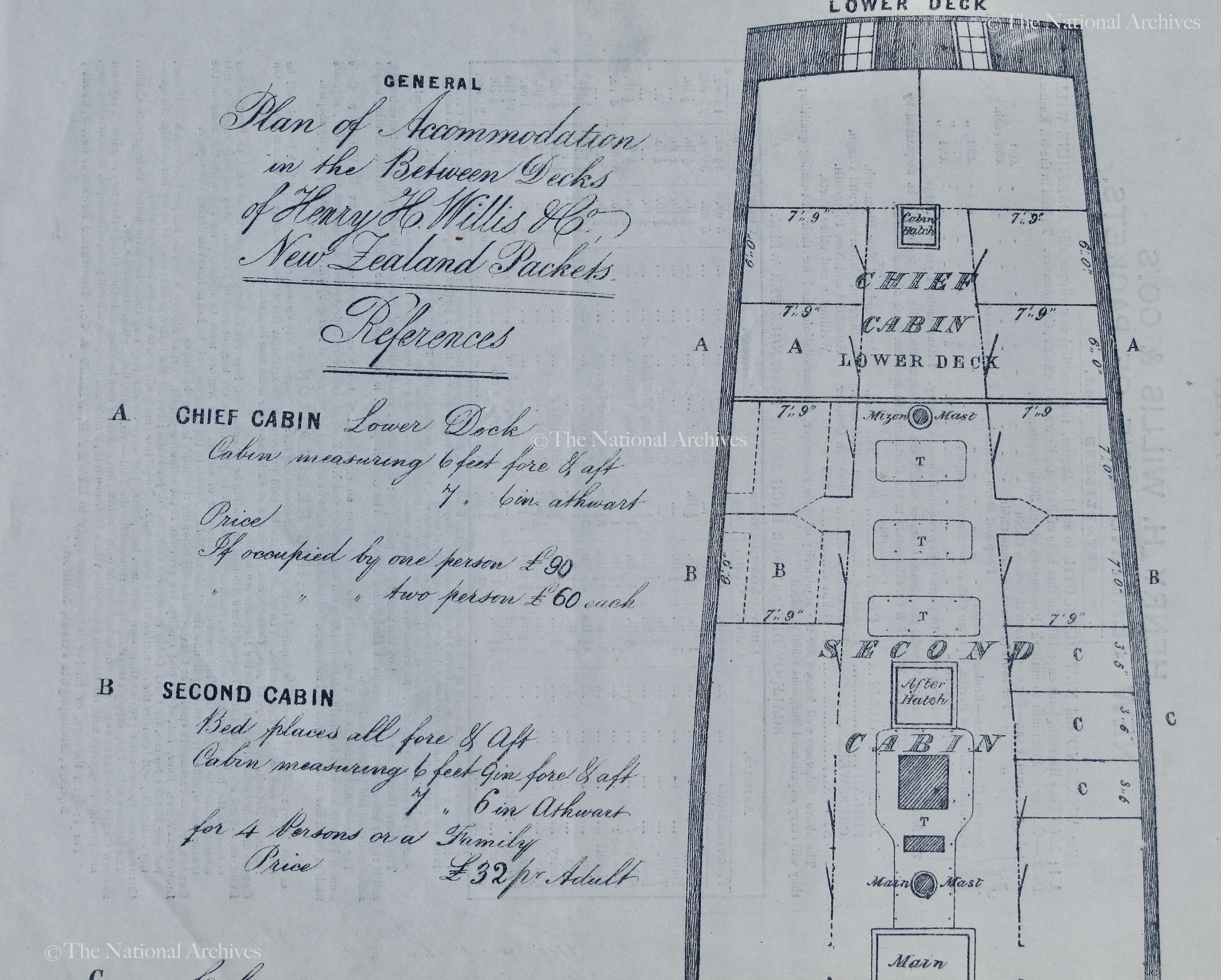
The information here is taken primarily from the surviving half of a double-sided advertisement for the maiden voyage of the Josephine Willis (BT 98/4231). The forward between-decks and poop deck plans are missing from the original, those sections have been interpolated here using data from other sources.
 |  BT 98/4231 National Archives (UK) |
An identical between-deck plan was reused in pamphlets for other ships in the Willis & Co. line; specific examples of these identical plans have been located for the vessels Simlah and Cashmere. While the between-deck layout appears to have been typical across these ships, the size and arrangement of the poop decks did vary enough for each to have its own diagram, specific to each ship.
Here the complete existing plan for the Simlah is used to act as a surrogate for the missing parts of the Josephine Willis plan. Although the Cashmere and Simlah were of similar sizes (about 800 tons), the plan for the Simlah shows a longer overall poop deck—about 45ft compared to 36ft for the Cashmere. The Josephine Willis was larger still, advertised at 1,000 tons and she had a poop of 56 feet. Other later vessels of the Willis & Co. Line, such as the Clontarf (1,500 tons) and the John MacVicar (1,100 tons), for which very similar documents still exists, used new plan imprints for their advertisements these demonstrate these later ships maintained a very similar internal layout to their predecessors. Most of the plans indicate a cabin reserved for the Captain within the poop deck.
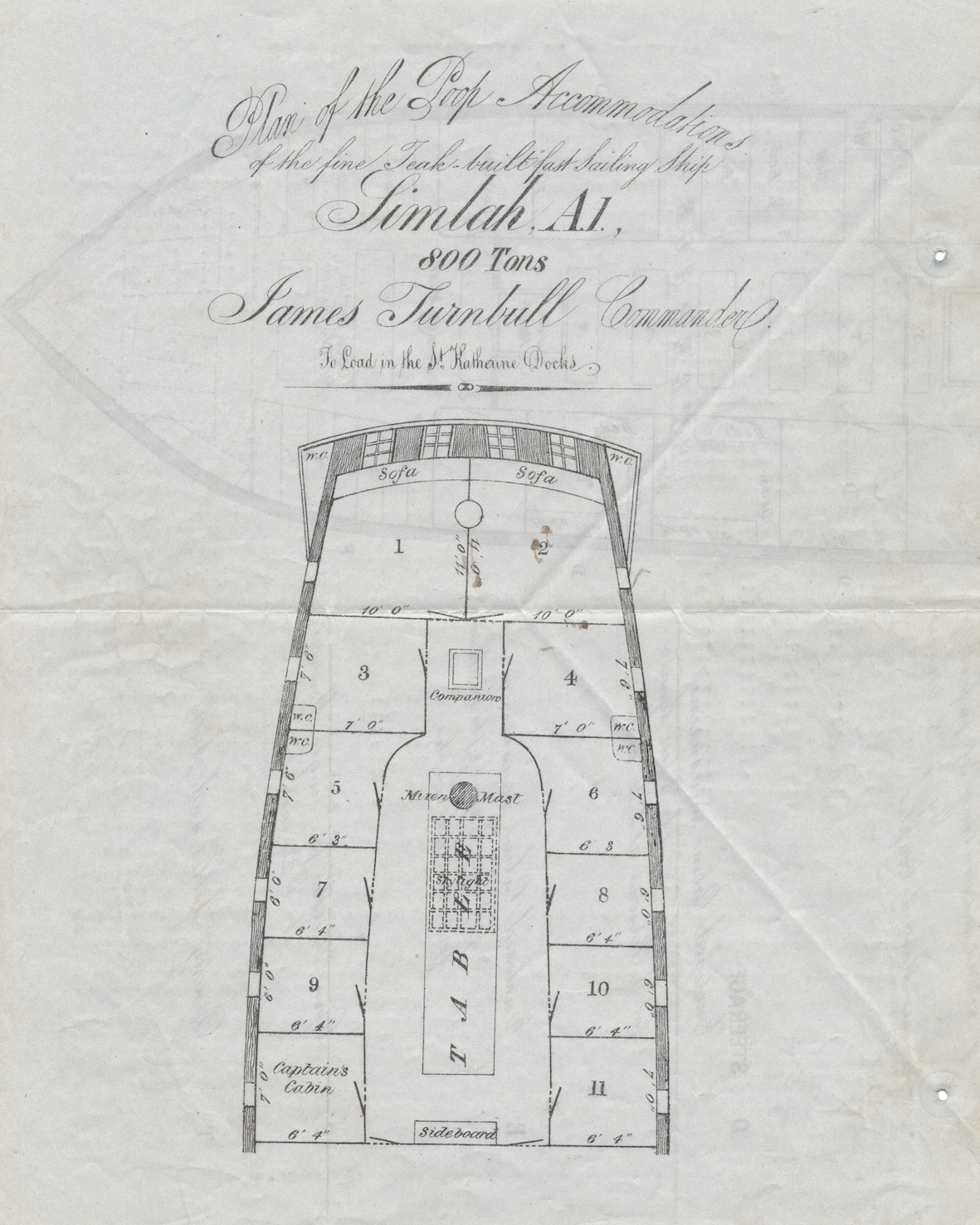 |  |
| Passenger Advertisement - Simlah | ARC2003-818 Puke Ariki (New Zealand) |
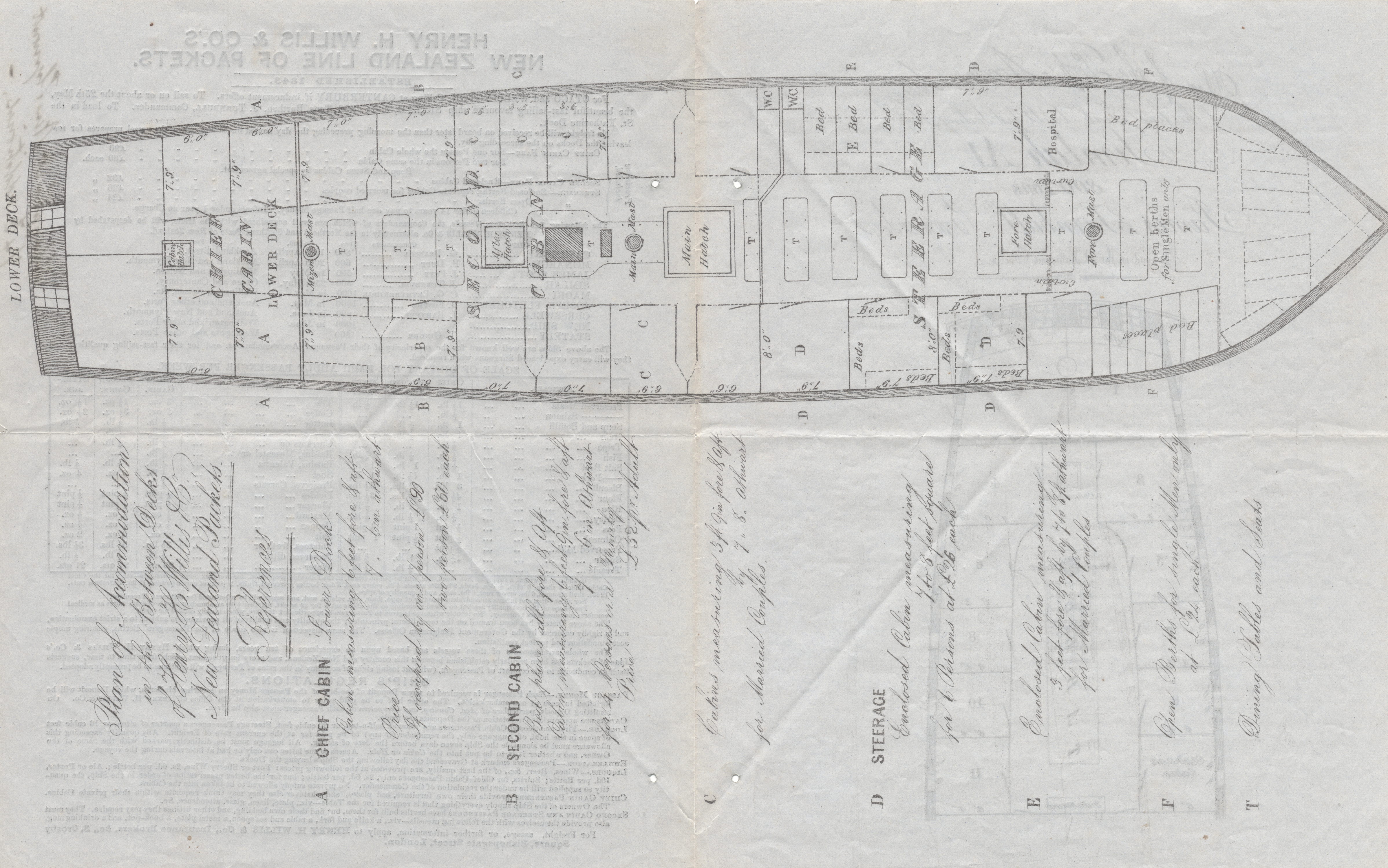 | |
Accommodations specifications.
A - Chief Cabin (Lower Deck) - Private cabins (6′ fore & aft × 7′ 6′′ athwart). Located at the stern for maximum light/ventilation. £90 for one person or £60 each person if two sharing.
B - Second Cabin – Enclosed cabins (6′ 9′′ fore & aft × 7′ 6′′ athwart) for 4 persons or a family, £32 per adult. Beds places all arranged fore & aft.
C – Second Cabin – Enclosed cabins (5′ 9′′ for & aft x 7′ 8′′ athwart) for married couples.
D – Steerage – Enclosed cabin (7 to 8 feet square) for 6 persons at £28 each.
E – Steerage – Enclosed cabin (5 feet fore & aft by 7 to 8 ft athwart for married couples.
F – Steerage – Open berths for single men only at £24 each.
Transcription of the Josephine Willis Advertisement:
HENRY H. WILLIS & CO.’S NEW ZEALAND LINE OF PACKETS. ESTABLISHED 1843.
For AUCKLAND and NEW PLYMOUTH, to sail in August, the beautiful new clipper ship JOSEPHINE WILLIS, A 1; 1000 Tons Burthen, built expressly for this Line of Packets, EDWARD CANNEY, Commander. To load in the St. Katharine Dock.—Calling at Plymouth to embark Passengers about 30th September.
Fares and Accommodations
Provisions included in the following fares:
| Accommodation Type | Fare |
|---|---|
| Chief Cabin Fare — For one Person the whole Cabin | £90 |
| Chief Cabin Fare — For two Persons in the same Cabin | £60 each |
| Chief Cabin Fare — Poop and Stern Cabins | By special agreement |
| Second Cabin Fare — Enclosed Cabins | £32 |
| Steerage — Enclosed Berths (separate Cabins for married couples) | £26 |
| Steerage — Open Berths | £24 |
Children under 14 years pay one-half passage money, and there is no charge for infants under 1 year.
Vessels of the New Zealand Line of Packets
The following fine first-class vessels, commanded by officers well acquainted with the trade, are despatched by Henry H. Willis & Co. alternately to the Northern and Southern ports of New Zealand:
| SHIPS | Commanders | Tons | To Sail | For |
|---|---|---|---|---|
| JOSEPHINE WILLIS | E. CANNEY | 1000 | 25th Sept. | Auckland and New Plymouth. |
| SIMLAH | T. ALLAN | 800 | 25th Sept. | Wellington, Canterbury, and Otago. |
| CRESSWELL | J. BARNETT | 800 | in October | Auckland and New Plymouth. |
| STATELY | T. GINDER | 800 | --- | Wellington and other Ports. |
These ships are known for their superior passenger accommodations and fast-sailing qualities, and they carry experienced surgeons when required.
Scale of Dietary for Each Adult Passenger Per Week
| Articles | Chief Cabin | Second Cabin | Steerage |
|---|---|---|---|
| Preserved Meats | 1 ½ lb. | 1 ½ lb. | ½ lb. |
| Preserved Salmon | ½ lb. | --- | --- |
| Soup and Bouilli | 1 lb. | ½ lb. | ½ lb. |
| Ham | 1 lb. | ½ lb. | --- |
| Tripe | ½ lb. | --- | --- |
| Fish | ½ lb. | ¼ lb. | ¼ lb. |
| Salt Beef | ½ lb. | 1 lb. | 1 lb. |
| Salt Pork | 1 lb. | 1 ½ lb. | 1 lb. |
| Biscuit | 3 lbs. | 4 ½ lbs. | 3 ½ lbs. |
| Flour | 4 ½ lbs. | 4 ½ lbs. | 3 ½ lbs. |
| Rice | 1 lb. | 1 lb. | ½ lb. |
| Barley | ¼ lb. | ½ lb. | ½ lb. |
| Peas | ½ pint | 1 pint | ½ pint |
| Oatmeal | ½ pint | ½ pint | 1 pint |
| Preserved Milk | ½ pint | --- | --- |
| Sugar | 1 ¼ lb. | 1 lb. | ¾ lb. |
| Treacle | --- | ¼ lb. | ¼ lb. |
| Tea | 3 oz. | 1 ½ oz. | 1 ½ oz. |
| Coffee | 5 oz. | 3 ½ oz. | 2 ½ oz. |
| Butter | ½ lb. | ½ lb. | ½ lb. |
| Cheese | ½ lb. | ¼ lb. | --- |
| Currants or Raisins | ¼ lb. | ¼ lb. | --- |
| Suet | ½ lb. | 6 oz. | 4 oz. |
| Preserved Carrots | ½ lb. | --- | --- |
| Pickles | ¼ pint | ¼ pint | ¼ pint |
| Vinegar | ¼ pint | ¼ pint | ¼ pint |
| Mustard | ½ oz. | ½ oz. | ½ oz. |
| Pepper | ½ oz. | ¼ oz. | ¼ oz. |
| Salt | 1 oz. | 1 oz. | 1 oz. |
| Potatoes Fresh | 3 ½ lbs. | 3 ½ lbs. | 3 ½ lbs. |
| Potatoes Preserved | ½ lb. | ½ lb. | ½ lb. |
| Water | 28 qts. | 21 qts. | 21 qts. |
Additional Provisions and Quality In addition to which, a supply of live stock, &c., will be put on board, in the following proportion, for every six adult passengers – viz for the Chief Cabin table, 2 sheep, 6 pigs, 6 dozen fowls, 9 bottles of sauces, ½ lb. celery seed, 3 dozen bottles of preserved fruits, 2 pints of currie powder, 12 lbs. Barcelona nuts, 12 lbs. shell almonds, 6 lbs. arrow root, 6 lbs. sago, and a quantity of spice. For children and infants an equivalent of sago, flour, rice, raisins, suet, and sugar will be substituted for salt meat, if required. Provisions of the best quality are put on board according to the above scale for 22 weeks, together with an abundant supply of extra stores as medical comforts for passenger generally. No trouble whatever is given to passengers in apportioning the fare, which is daily cooked for them.
Regulations and General Information The above dietary has been framed on the most liberal principles; the quantity and quality of all provisions is subject to strict examination, and is rigidly enforced by Government Emigration Officers. The same inspection is also made of the Passenger’s berths, ensuring ample accommodation and perfect ventilation.
The whole arrangements of these vessels are based upon an experience of ten years, during which Henry H Willis & Co.;s Line of Packets has been regularly established between this country and New Zealand, and every improvement which, from time to time, suggests itself as conducive to the comfort of Passengers, (without losing sight of economy in the rates of Passage, ) will continue to be promptly adopted. by Henry H. Willis & Co.
SHIP’S REGULATIONS
Passage Money: Each Passenger is required to pay a Deposit of one-half of the Passage Money on securing his berth, which Deposit will be forfeited in case of non-embarkation. The other half to be paid prior to embarkation at the Office of Henry H. Willis & Co. On remitting deposit, particulars of Age, Country, and Occupation of each passenger must also be given.
Cabins are appropriated in rotation as the Deposits are made.
Luggage: First and Second Cabin Passengers are allowed half-a-ton, or 20 cubic feet; Steerage Passengers a quarter of a ton, or 10 cubic feet of space in the hold, of Luggage only, the reminder (if any) to be paid for at the current rate of freight. Any quantity exceeding this allowance must be alongside the ship seven days before the date of sailing. All luggage must be distinctly marked with the name of the Owner, and whether it is to be put into the Cabin or Hold. Access to the latter can only be had at intervals during the voyage.
Embarkation: Passengers embark at Gravesend the day following the Ship's leaving the Docks.
Liquors: Wines, Beer, &c., of the best quality, are provided at following prices: Port or Sherry Wine, 2s. 6d. per bottle; Ale or Porter, 10d. per bottle; Spirits, for Chief Cabin Passengers only, 2s. 6d. per bottle; but for the better preservation of order in the ship, the quantity do supplied will be under the regulation of the Commander. No private supply allowed to be taken into the Cabins.
Chief Cabin Passengers provide their own furniture, bed places, and whatever else they think requisite within their private cabins. The owners of the ship supply everything that is required for the table – viz, plate, linen, glass, attendance, &c.
Second Cabin and Steerage Passengers have berths built for them, but find their own bedding, and other fittings they may require. They must also provide themselves with the following utensils – viz., a knife and fork, a table and tea spoon, a metal plate, hook-pot, and a drinking mug.
For freight, passage, of further information, apply to Henry H. Willis & Co., Insurance Brokers, &c., 3, Crosby Square, Bishopsgate Street, London.